


SEO Services: What a Strategic Programme Covers in 2026
SEO that stops at rankings is an expensive distraction. If SEO services sound interchangeable, proposals may be listing tasks without explaining how technical fixes, content and authority-building work together or support revenue. The useful question is not just what gets done, but why each activity deserves a place in the growth plan.
Effective SEO brings together a sound technical foundation, useful and credible content, and measurement tied to commercial priorities. This guide explains the core disciplines in a strategic programme and how to assess progress beyond rankings and traffic, including through qualified enquiries, conversions and contribution to pipeline.
You’ll also learn how priorities can adapt as search behaviour shifts across traditional results and AI-powered discovery, while retaining the fundamentals that make a site accessible, relevant and trustworthy. SayMe Marketing connects AI-driven SEO and AEO with business priorities, supported by data-backed performance and transparent reporting. Use this guide to distinguish disconnected activity from a programme designed to strengthen visibility and business value over time.
Key Takeaways
- See how SEO services combine technical foundations, useful content and authority to support search visibility.
- Follow a programme sequence from business goals and site diagnosis to prioritised implementation and review.
- Separate visibility and engagement indicators from business outcomes to assess performance more clearly.
- Prioritise work around audience intent, site condition, content gaps and business objectives, not a generic checklist.
- Learn how SayMe Marketing connects AI-driven SEO and AEO with data-backed measurement and ongoing optimisation.
What SEO services cover: the disciplines behind sustainable search visibility
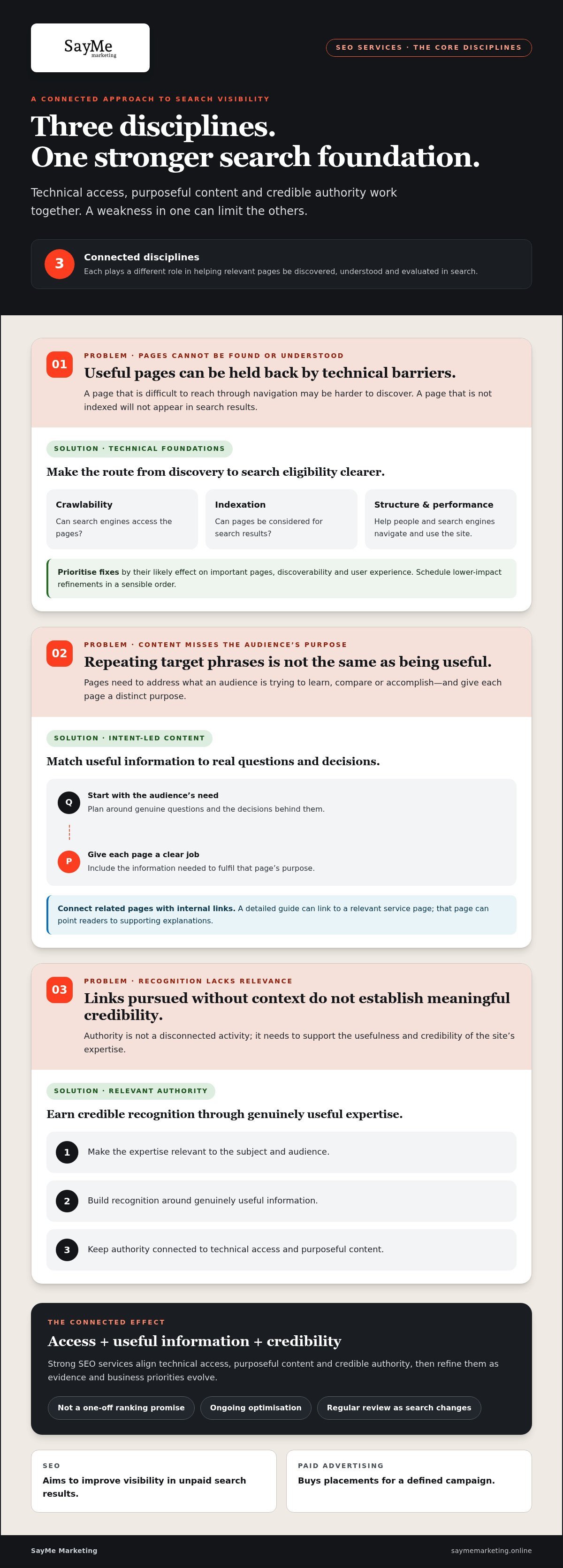
SEO services improve how relevant pages are discovered, understood and evaluated in search. A strategic programme connects three disciplines: technical foundations help search engines access pages, content explains what those pages offer, and authority helps establish their credibility. A weakness in one area can limit the others. For example, useful content may struggle to perform if search engines can’t find or index the page.
SEO is ongoing optimisation, not a one-off promise of a particular ranking. Search behaviour, websites and competitors change, so priorities need regular review. The Search Engine Optimization (SEO) overview on Wikipedia provides useful context on the discipline’s history and techniques. The commercial distinction is straightforward: SEO aims to improve visibility in unpaid search results, while paid advertising buys placements for a defined campaign.
Technical SEO services: Help search engines access and understand a website
Technical work supports the route from discovery to a page becoming eligible to appear in search. Crawlability is whether search engines can access pages; indexation is whether those pages can be considered for search results. A clear site structure helps users and search engines understand how information is organised, while page performance affects the experience after a visitor arrives.
A technical issue can undermine an otherwise useful page. A page that users can’t reach through site navigation may be harder to discover; a page that isn’t indexed won’t appear in search results. Don’t treat every issue as equally urgent. Prioritise fixes by their likely effect on important pages, discoverability and user experience, then schedule lower-impact refinements in a sensible order.
Content and authority services: Match useful information to search demand
Content should answer what an audience is trying to learn, compare or accomplish, not simply repeat target phrases. Intent-led planning starts with genuine questions and the decisions behind them. A business serving other businesses, for instance, may need clear explanations of a complex service and pages that help decision-makers assess whether it fits their needs. Give each page a distinct purpose and the information needed to fulfil it.
Internal links connect related pages, giving readers useful next steps and helping search engines interpret how the information fits together. A detailed guide might link to a relevant service page, while that page can point to supporting explanations. Authority building also depends on relevance: it means earning credible recognition through genuinely useful expertise, not pursuing links without context. Strong SEO services align technical access, purposeful content and credible authority, then refine them as evidence and business priorities evolve.
How an SEO services programme moves from diagnosis to implementation
A useful SEO assessment doesn’t end with a long list of faults. It identifies which issues restrict performance, which opportunities support business goals and what should happen first. That turns diagnosis into a workable programme rather than a backlog that’s difficult to act on.
Use this sequence to follow the work from evidence to action:
- Understand business goals. Define the outcomes that matter, such as attracting relevant enquiries, supporting a priority service or reaching a new audience.
- Assess the site. Review site structure, organic visibility, audience needs and how current pages support commercial priorities.
- Prioritise the work. Separate barriers that limit discoverability from content or structural opportunities that can be sequenced over time.
- Implement improvements. Coordinate technical updates and content changes, with clear ownership and a shared understanding of what each action is intended to address.
- Review the evidence. Check what changed, what the data indicates and whether the next priorities still fit the business.
SEO priorities should follow business goals and search evidence, not a generic checklist. That keeps effort focused. Michigan Technological University’s guide to SEO also discusses relevant content and technical optimisation, useful foundations to consider in context.
From SEO assessment to a prioritised roadmap
A roadmap connects the site’s current condition with audience needs and organisational objectives. If a priority service page is difficult to find and has little relevant supporting information, for example, the response may involve improving navigation and strengthening the content around it. The assessment should explain why those actions matter, not just label them as tasks.
Separate critical barriers from improvements that can be planned in stages. An issue affecting many important pages may need attention before content is expanded; a narrower opportunity could be scheduled alongside other work. Agreed priorities make the plan realistic against available resources and give each action a purpose, sequence and basis for review.
Implementation, learning and ongoing optimisation
Check implementation, rather than treating completion as the finish line. After a technical update, confirm that the intended pages remain accessible and that the change hasn’t disrupted related parts of the site. After improving content, check that the page addresses its intended audience need and fits logically with connected information. This links recommendations to their actual effects.
Then use performance evidence to refine the roadmap. If a change addresses a barrier but expected visibility or engagement signals don’t follow, investigate before repeating the same approach elsewhere. Reassess the plan when business priorities or search behaviour change. A focused SEO programme shaped around business objectives keeps diagnosis, delivery and learning connected as conditions evolve.
How to assess SEO services by business impact, not rankings alone
A ranking can rise without producing a meaningful business result. Impressions can grow while the pages attracting visibility reach the wrong audience. To assess SEO services commercially, read performance in layers: can people see your pages, what do they do after arriving, and do their actions support a business objective?
SEO reporting should connect search visibility with the outcomes the business tracks. These measures answer different questions, so no single column proves success on its own.
| Measurement layer | Examples | What it helps you assess |
|---|---|---|
| Visibility indicators | Search impressions, clicks, query and page visibility | Whether relevant pages are appearing in search and attracting visits |
| Engagement signals | Landing-page engagement, engaged sessions, next-page actions | Whether visitors find the page relevant enough to explore further |
| Business outcomes | Tracked enquiries, qualified leads, organic conversions | Whether organic activity is contributing to the outcomes the business values |
Rankings and impressions provide context, not proof of commercial value. A page may gain visibility for a broad query but attract few qualified visitors. A smaller number of visits to a relevant service page may instead lead to enquiries that better match the organisation’s goals. Interpret both against the page’s purpose and the quality of the actions it supports.
Which SEO metrics belong in a useful performance report?
Google Search Console and Google Analytics 4 offer different measurement perspectives. Search Console helps assess how pages perform in Google Search, including impressions and clicks. GA4 helps analyse what users do on the website, such as landing-page engagement and recorded conversions. Together, they can show more of the journey, but they don’t automatically establish that SEO caused a particular outcome.
Tracking configuration matters. A conversion needs to be defined and recorded consistently, and attribution depends on how the measurement setup assigns credit across interactions. If enquiry forms aren’t tracked properly, reports may understate outcomes. If several channels contribute, organic search may be one influence rather than the only cause. Semrush’s SEO best-practice guidance offers additional context on building sound search foundations, but reporting should reflect your own agreed objectives.
How to interpret progress without expecting instant rankings
Compare trends with a clear baseline and the programme’s agreed objectives. Review performance across relevant pages and queries rather than treating one keyword position as a verdict. Search results can vary, and a single ranking says little about the full picture of visibility, engagement and outcomes.
Expect transparent reporting: what work was completed, what changed in the evidence, what remains uncertain and what happens next. This turns measurement into decisions. It also helps refine priorities when data shows that a page is visible but not attracting relevant visits, or that qualified organic traffic is contributing to tracked enquiries.
How to prioritise SEO services for your audience and evolving search behaviour
There’s no universal SEO checklist. The right sequence depends on who the business needs to reach, what its website can support and which outcomes matter most. Strong SEO services start with that fit, balancing foundational work with opportunities to expand visibility. A technical barrier affecting priority pages may need attention before new content; a healthy site with clear content gaps may be ready to develop relevant topics.
Match SEO priorities to the audience and business objective
Start with audience intent. A B2B business may need to reach decision-makers researching a complex service, while a multi-niche organisation may serve distinct audiences with different questions and routes to enquiry. Treating every topic as equally valuable spreads effort thinly. Map the audiences that matter, the information they need and the business action each page should support.
Then match each page to its purpose. An educational guide should answer a real question and connect readers to relevant next steps. A service page should explain the offer clearly and make the route to enquiry easy to understand. That purpose shapes the content, internal links to related pages and measures used to assess performance. Prioritise gaps supported by audience needs, site evidence and strategic fit rather than copying a competitor’s checklist.
Separate essential foundations from growth opportunities. If important pages are difficult to access or poorly organised, resolve those constraints first. If the foundations are sound, focus may shift to strengthening relevant topics, improving existing pages or addressing needs the site doesn’t yet cover. Set the sequence according to the site’s condition and available resources, not a fixed package of tasks.
Prepare content for search engines and AI-assisted discovery
Clear, accurate answers help people understand a page and make its purpose easier to interpret. Use descriptive headings, logical sections and precise language. Put the answer where readers can find it, then provide the context, evidence or practical detail needed to make it genuinely useful. Avoid thin pages that repeat the same points across multiple topics.
Established SEO and answer engine optimisation (AEO) can work together. SEO supports discoverability across search; AEO places added emphasis on making useful information clear and accessible to answer-oriented experiences. Neither guarantees inclusion in a particular result or AI-generated response. Search features and AI behaviours can change, so verify claims about specific platforms and features before relying on them in a strategy.
For a deeper discussion of these shifts, see SEO and AEO: How search visibility is changing. SayMe Marketing connects AI-driven SEO and AEO with business priorities through a data-backed approach. Find out more about SEO and AEO strategy for your business.
What a strategic SEO services programme with SayMe Marketing delivers
Effective SEO isn’t a disconnected series of fixes or a report built around rankings alone. It should fit your business objectives, reach the audiences that matter and connect planned work with transparent measurement. SayMe Marketing brings these priorities together through AI-driven SEO and AEO, using a data-backed approach to inform decisions and ongoing optimisation.
A programme should make the relationship between strategy, delivery and review clear. The right activity depends on your audience, website and commercial goals. No ranking can be guaranteed, but priorities can be grounded in evidence, reported openly and refined as performance and business needs evolve.
How SayMe Marketing connects SEO and AEO to business priorities
SEO and AEO support discovery in different but connected ways. SEO focuses on making relevant pages accessible and useful for people searching for information, products or services. AEO adds a focus on presenting clear, credible information for answer-oriented discovery. The objective isn’t to chase every emerging search format, but to strengthen visibility in ways that align with your audience and business direction.
For a B2B business, that may mean shaping content around the questions decision-makers ask before enquiring. For a multi-niche organisation, it may mean clarifying which audiences and areas of the site deserve attention first. Strategy establishes the fit; implementation puts agreed work into action; performance review helps determine what to refine next. SayMe Marketing’s team brings over 25 years of combined experience to this work, supported by transparent reporting that shows activity and evidence without presenting rankings as promised outcomes.
That accountability matters. A useful programme makes clear why work is prioritised, what has been completed and how the available evidence informs the next decision. SayMe Marketing connects AI-driven SEO and AEO with business priorities rather than treating either discipline as a standalone trend.
Choose a clear next step for your SEO programme
Start by stating the business objective and the audience you need to reach. Be specific: are you aiming to increase relevant enquiries, improve discovery of a priority service or build visibility around a defined topic? Clear answers provide a decision-making framework and help distinguish strategically valuable work from activity that merely adds volume.
If budget planning is part of your decision, read SEO agency fees: What should your budget cover? to consider what an investment may need to account for. Then assess whether your current priorities, delivery and reporting form a coherent programme. Strong SEO services make that connection visible, from the rationale for the work to the evidence used to review it.
Explore SEO and AEO with SayMe Marketing to learn how a search programme can align with your business.
Make your next search investment count
Turn your business objective into a clear decision about where search can contribute. Define the audience you want to reach, the action you want them to take and the evidence that would help you judge progress. This gives SEO services a commercial purpose and keeps future investment accountable.
SayMe Marketing brings over 25 years of combined team experience to SEO and AEO, supported by data-backed performance and transparent reporting. The work connects search visibility with business priorities without promising a particular ranking or outcome. Its value lies in making informed choices, learning from evidence and refining the programme as your organisation evolves.
Ready to turn your search priorities into a considered programme? Explore SEO and AEO with SayMe Marketing.
Frequently Asked Questions
What do SEO services include?
SEO services can include technical improvements, content optimisation, internal linking, authority development and performance reporting. The mix should reflect the website’s needs and the audience it must reach. For example, a business launching a new service may need its existing pages reviewed alongside a plan for introducing that service online. A clear programme explains why each activity matters, what it is intended to address and how it will be assessed, without promising a particular ranking.
How long does SEO take to show results?
There’s no reliable fixed timeline for SEO results. The website’s starting condition, competition, implementation pace and changes in search all influence progress. To assess movement fairly, record a baseline before work begins, note when key changes go live and compare later performance with the programme’s objectives. This helps distinguish the effect of completed work from normal fluctuations without treating an early change as proof of lasting commercial impact.
Can a business do SEO without publishing a blog?
Yes. A blog isn’t a requirement for SEO. A business with a focused offering may benefit more from improving its core service pages than from publishing articles on a fixed schedule. For instance, a page could better explain who a service is for, what problem it addresses and what a prospective customer can do next. Choose formats based on real audience needs and each page’s purpose, not an assumed publishing quota.
Is SEO still relevant as more people use AI search?
Yes. People still need to find and assess reliable information, and established SEO practices help businesses make relevant pages accessible and understandable. AI-assisted discovery adds another reason to present accurate information in a clear structure, but it doesn’t make SEO obsolete or guarantee that a page will appear in an AI response. Treat answer engine optimisation (AEO) as a complementary consideration, and verify claims about particular search features as they change.
What is the difference between SEO and paid search?
SEO aims to improve a website’s visibility in organic search results; paid search uses advertising platforms to display adverts. Organic visibility is developed through work on a website and its content, while paid placements depend on active campaigns and media spend. The two channels can support different objectives and work together. Compare them by audience, intent and the outcomes each is intended to support, rather than assuming one always replaces the other.
Do SEO services guarantee first-page rankings?
No. A responsible SEO programme can’t guarantee a specific position because search results are affected by changing factors beyond an agency’s control. Treat a ranking goal as an ambition, not a contractual certainty. A more credible assessment considers whether agreed work was completed, whether relevant visibility changed and whether the activity supports business objectives. Be wary of reports that present one keyword position as the entire measure of performance.
How should a business know whether its SEO is working?
Look for evidence connecting organic discovery with useful website actions. Google Search Console can show search impressions and clicks, while Google Analytics 4 can help analyse on-site behaviour and configured conversions. A tracked enquiry form submission, for example, shows that a visitor took action, but the business still needs to assess lead quality. Check that tracking works consistently, then interpret the signals against a baseline and agreed objectives.
1 Comment
SEO Digital Marketing Agency: Make Search Visibility Drive Growth
October 10, 2026[…] doesn’t bring the right people closer to becoming customers? Search behaviour is changing, and an SEO digital marketing agency must do more than improve positions in traditional results. It needs to help your business get […]