


LinkedIn Advertising in 2026: A Practical Guide to B2B Growth
What if LinkedIn advertising isn’t the wrong channel, but your audience, offer and measurement aren’t aligned? For South African B2B businesses, the platform can put campaigns in front of professional audiences. But simply launching an advert isn’t a growth strategy. Without a clear commercial objective, spend can generate activity without showing whether it contributes to your pipeline.
That uncertainty is understandable. Campaign Manager offers multiple objectives, targeting options and ad formats, and each decision affects who you reach and how you measure results. The answer isn’t to avoid the platform or spend more blindly. It’s to build campaigns around a specific business outcome, then track performance beyond clicks and impressions.
This guide explains how LinkedIn advertising works, when it makes sense for your audience and what to define before launch. You’ll learn how campaign objectives, targeting and creative fit together, and how to connect measurement to qualified leads, pipeline and revenue. The goal is a disciplined approach that helps you assess whether LinkedIn belongs in your B2B strategy and make each campaign accountable to business performance.
Key Takeaways
- Assess whether LinkedIn’s professional audience and B2B role match your business goals before committing budget.
- Align the campaign objective, audience, budget and creative so each part supports the same outcome.
- Use linkedin advertising metrics to diagnose delivery and engagement, then assess conversions and downstream commercial impact.
- Plan your launch around a defined business objective, a relevant offer and a measurement approach you can act on.
- Strategic management and transparent reporting can help connect campaign activity to business priorities and guide better decisions.
What LinkedIn advertising does for a business, and when it fits
LinkedIn advertising is paid promotion on LinkedIn that reaches selected professional audiences and encourages them to take a defined next step. That step might be learning about your organisation, exploring a solution or submitting an enquiry. The platform’s professional networking context is central to its role; LinkedIn’s advertising capabilities sit within a network where members build professional connections and engage with business-related content.
For a South African B2B business, the channel can be a fit when its buyers use LinkedIn professionally and its offer addresses a clear business need. It can introduce your organisation to new prospects, help buyers assess a solution, or encourage enquiries when there’s a relevant offer. But a professional audience alone isn’t a reason to advertise. If your buyers aren’t reachable there, or the offer doesn’t match their needs, paid distribution won’t fix the underlying mismatch.
How LinkedIn advertising differs from organic activity
Organic activity means unpaid posts shared by a company page or an individual. Their distribution depends on the people who follow or encounter those posts. Paid campaigns use budget to distribute selected messages to chosen audiences, helping extend reach beyond an existing follower base. This gives a business more control over who sees a message and what action it is designed to prompt.
More reach doesn’t prove commercial effectiveness. Impressions show that an advert was displayed, but not that the right people engaged, became qualified leads or contributed to revenue. Treat reach as a delivery signal, then assess it alongside audience relevance and business outcomes. Paid activity and organic content can play complementary roles, but each needs a clear job.
Which business goals can LinkedIn support?
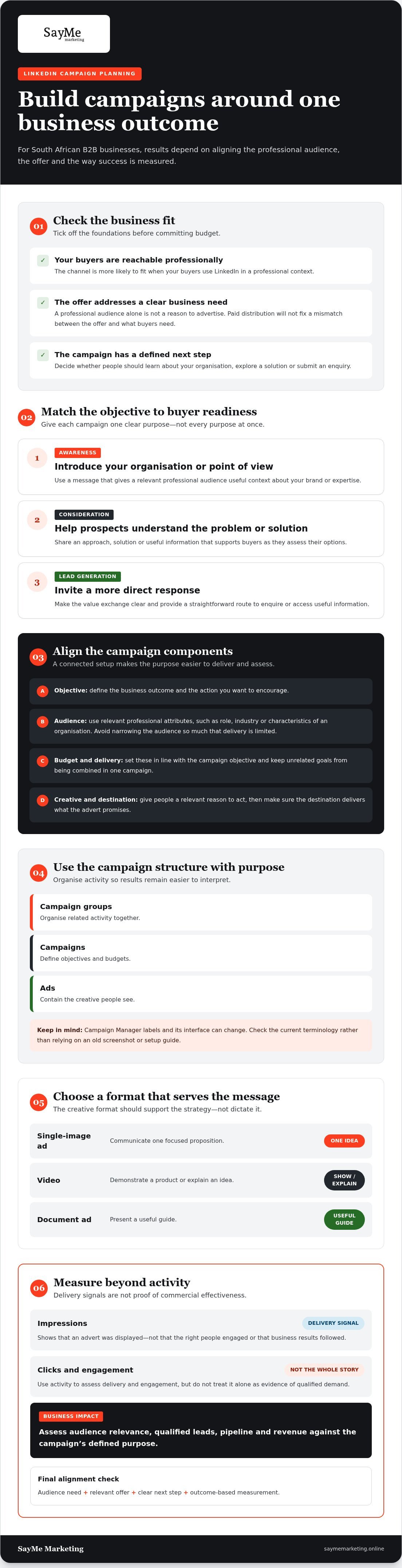
Match the objective to the buyer’s stage and the strength of your offer. Awareness activity can introduce a brand or point of view to a relevant professional audience. Consideration campaigns can help prospects understand a problem, approach or solution. Lead generation can invite people to take a more direct step, such as enquiring about a service or accessing useful information.
Don’t ask one campaign to serve every purpose. A prospect who has never heard of your business may need context before responding to a sales-led message. Someone already comparing solutions may be ready for a more specific offer. Define the audience, the value you’re presenting and the next action before choosing an objective. Then judge performance against that purpose, not simply the volume of activity.
This is where channel planning matters. SEO and search visibility can help prospective customers find relevant information through organic search, whilst paid LinkedIn activity can put a message in front of selected professional audiences. The right mix depends on how buyers discover and evaluate your offer. LinkedIn advertising earns its place when the audience, offer and intended business outcome align.
How LinkedIn advertising campaigns are structured and delivered
LinkedIn advertising works as a sequence of connected decisions, not as a single advert switched on in isolation. The objective sets the intended outcome; the campaign structure organises delivery; audience and budget settings guide distribution; and the creative gives people a reason to act. A well-structured campaign connects one business objective to a specific audience, a relevant advert and a measurable next step.
From campaign objective to advert
Start with the action you want to encourage. An awareness objective calls for a message that introduces your organisation or expertise. A lead generation objective needs a clear value exchange and a straightforward route to enquire. The chosen objective shapes the campaign setup, including the delivery and measurement settings that matter.
At a broad level, campaign groups can organise related activity, individual campaigns define objectives and budgets, and the ads contain the creative. Targeting and delivery settings sit within that structure, although LinkedIn’s labels and interface can change. In 2026, check the current Campaign Manager terminology rather than relying on an old screenshot or outdated setup guide. The principle remains stable: organise campaigns around a clear purpose instead of combining unrelated goals and making results harder to interpret.
Creative format should serve the message, not dictate the strategy. A single-image ad can communicate one focused proposition; a video can demonstrate a product or explain an idea; a document ad can present a useful guide. The destination matters just as much. If the advert promises practical insight, the linked page should deliver it without forcing visitors through an unrelated sales journey. LinkedIn’s LinkedIn Ads best practices offer an official reference point for campaign planning and professional audience considerations.
Audience selection and delivery in practice
Audience choices should reflect how your buyers are defined in the real world. Depending on the options available in Campaign Manager, professional attributes may include a person’s role, industry or characteristics of their organisation. Be precise about who is relevant, but avoid narrowing the audience so much that the campaign has little room to deliver.
Relevance comes from the connection between audience need, offer and creative. For example, a business promoting a specialist service to finance leaders should explain a problem those decision-makers recognise, rather than rely on generic claims about innovation. If the message speaks to a different role or need, carefully chosen audience settings can’t make the offer compelling.
Budget settings establish the resources available to the campaign, whilst delivery determines how the platform serves ads within the chosen setup. Treat both as variables to manage, not evidence of success in themselves. Review whether the campaign is reaching the intended professional audience and whether the resulting actions support its objective. For a more disciplined setup, SayMe Marketing’s LinkedIn marketing can bring campaign structure, execution and reporting into alignment with your business priorities.
Measure LinkedIn advertising by business impact, not clicks alone
Clicks and impressions tell you what happened at the top of a campaign, not whether it created commercial value. A click can indicate interest; an impression can confirm delivery. Neither proves that a suitable prospect took action, progressed towards a sales conversation or became a customer. A useful measurement framework follows the path from delivery to business outcome.
Assess performance across four connected layers. Each answers a different question, so avoid treating an early signal as a final result.
| Metric category | Examples | Business question |
|---|---|---|
| Delivery indicators | Impressions, reach, frequency | Did the campaign serve to its intended audience? |
| Engagement signals | Clicks, reactions, video views | Did people notice or interact with the message? |
| Conversion actions | Enquiries, form submissions, requested next steps | Did someone respond to the offer? |
| Commercial outcomes | Lead quality, sales conversations, pipeline progression, revenue | Did the activity contribute to business growth? |
Choose metrics that match the campaign objective
For an awareness campaign, assess delivery and relevant engagement first. Don’t demand immediate lead volume if the purpose is to introduce your business to a professional audience. For lead generation, look beyond submission totals: assess whether enquiries match your target customer profile and progress into meaningful sales conversations. Impressions and clicks are early signals; sales outcomes may take longer to emerge, particularly in considered B2B purchasing journeys.
Define what a qualified lead means with your sales team before launch. For example, agree which business need, role or buying stage makes an enquiry worth pursuing. This prevents a high volume of low-fit submissions from being mistaken for success. Match the reporting window to the campaign’s objective and sales process, rather than judging every activity on the same timetable.
Build a credible measurement loop
Before launch, record a baseline and set success criteria tied to the objective. Decide which actions count as conversions, who will review lead quality and how campaign influence will be assessed. Use LinkedIn’s available conversion measurement options and CRM records where appropriate, and verify current platform features, integration availability and setup requirements before relying on a specific data flow.
Attribution needs agreed rules. A prospect may see an advert, return later through search and then speak with sales. Last-click reporting could credit only the final interaction, whilst a broader view can show LinkedIn’s role earlier in the journey. No single model tells the whole story. Document what each model includes, and don’t present attributed revenue as unquestionable proof of causation.
Close the loop with transparent reporting that records assumptions, results and optimisation decisions. If engagement is strong but qualified enquiries are weak, investigate the offer, landing experience and lead criteria before increasing distribution. This is how linkedin advertising becomes a source of evidence for better decisions, rather than a dashboard of disconnected activity.
Plan a LinkedIn advertising campaign with a practical launch sequence
A disciplined launch begins before you open Campaign Manager. Define the commercial purpose first, then build the offer, message and measurement around it. This keeps linkedin advertising focused on a business need rather than platform settings for their own sake.
- Set the business objective. State the outcome in plain language, such as introducing a service to relevant decision-makers or generating enquiries from prospective customers.
- Define the audience. Describe the professional buyers most likely to need the offer. Use roles, industry and organisational context to guide planning, without assuming everyone in a broad category is a suitable prospect.
- Shape the offer around buyer readiness. Decide what useful next step makes sense for someone at that stage, from learning more to starting a sales conversation.
- Choose the campaign approach. Select an objective and creative format that support the intended action. Keep the message focused, with one clear proposition and a next step that’s easy to understand.
- Prepare the destination. Make sure the landing page explains the offer, supports the advert’s claims and gives visitors a clear route to act.
- Set measurement before launch. Agree how you’ll assess delivery, engagement, conversion actions and lead quality, and who will review those signals.
Clarify the offer before choosing campaign settings
Write a short campaign brief: what business problem are you addressing, who needs to recognise it, and what should they do next? Then check that the offer matches the buyer’s context. A prospect encountering your brand for the first time may need useful information before a direct sales invitation. A buyer already evaluating options may respond to a more specific proposition.
Keep every promise consistent. If an advert promotes a guide, the destination should provide it without making visitors search. If it invites prospects to enquire about a service, the page should explain what the service addresses and how to take the next step. A mismatch between advert and page erodes trust and can undermine campaign performance.
Test, learn and optimise responsibly
Once the campaign is live, test a meaningful variable at a time when there’s enough campaign activity to interpret the result. For example, compare two distinct message angles whilst keeping other elements consistent. Changing the audience, offer, creative and landing page together makes it difficult to identify what influenced a shift in performance.
Review platform engagement alongside lead quality and business signals. If people interact but few suitable prospects progress, reassess the offer or destination before simply increasing distribution. Use the evidence to refine the message, landing-page experience or campaign settings. Treat each adjustment as a decision informed by results, not a promise of a particular outcome.
If you want expert support turning this sequence into a managed campaign, plan your LinkedIn marketing with SayMe Marketing, with business objectives and performance reporting built into the approach.
Turn LinkedIn advertising into a managed growth channel with SayMe Marketing
A campaign becomes a growth channel when its purpose, execution and evaluation stay connected. LinkedIn advertising should serve a defined business objective, reach professionals whose needs match your offer, and generate evidence that helps you decide what to do next. Without that strategic link, activity can become a series of disconnected adverts and reports.
What disciplined campaign management should connect
SayMe Marketing brings LinkedIn marketing into a broader, data-backed digital strategy. Campaign decisions should align with business priorities, not treat platform activity as a standalone exercise. Audience needs shape the message; the message supports a relevant action; and reporting helps assess whether that action contributes to the intended outcome.
Measurement must support decisions. A transparent report should distinguish delivery and engagement from conversions and downstream commercial signals. It should make clear what the data shows, what assumptions inform interpretation and which changes are being considered. If an advert attracts attention but not relevant enquiries, the response might be to revisit the offer or message. If leads come through but stall before a sales conversation, the issue may sit further along the customer journey. Let the data guide the question, rather than presenting it as proof of guaranteed growth.
This approach draws on SayMe Marketing’s wider expertise in paid advertising, SEO, social media, marketing strategy and consulting. These channels can serve different roles in a B2B plan, and a joined-up view helps keep each activity focused on a business purpose. The team brings over 25 years of combined experience across its work.
Decide on the next step for your LinkedIn strategy
Before launch, make three decisions clear: the business goal, the offer you’ll put in front of a relevant audience, and the measurement plan you’ll use to assess progress. Those foundations make it easier to choose campaign settings, judge performance fairly and identify where refinement is needed. Keep the plan practical, then use reporting to inform each next move.
SayMe Marketing can shape and manage a LinkedIn marketing approach around your business objectives, with data-backed execution and transparent reporting. A defined objective, a relevant offer and a clear measurement plan help move beyond disconnected campaign activity.
Make your next campaign a deliberate move
Give your next campaign a clear strategic role before committing resources. Decide which business priority it should advance, what you need to learn about your audience and what evidence would justify the next investment. That turns linkedin advertising into more than a launch: it becomes a structured way to test a commercial hypothesis and make sharper decisions over time.
You don’t need to solve every channel or campaign question at once. Start with one audience, one relevant offer and a defined measure of progress. As evidence accumulates, use it to refine your approach and build a stronger connection between marketing activity and business priorities.
To shape your next step around your objectives, explore LinkedIn marketing with SayMe Marketing and discuss a campaign approach built for clear decisions and accountable execution.
Set the direction, measure what matters and give your B2B growth strategy room to advance.
Frequently Asked Questions
What is LinkedIn advertising and how does it work?
LinkedIn advertising lets a business pay to promote content or offers to professional audiences on the platform. You choose a campaign goal, define who you want to reach, set delivery and budget parameters, then create an advert that invites a relevant action. For example, a software firm could promote a product demonstration to professionals involved in evaluating that type of solution, then assess the resulting enquiries.
Is LinkedIn advertising suitable for small businesses?
It can suit a small business if its audience is identifiable on LinkedIn and the value of reaching those prospects justifies a paid campaign. A specialist consultancy, for instance, might focus on a defined group of decision-makers rather than trying to reach everyone. Start with a focused objective and a manageable test, then use lead relevance and sales progression to decide whether to continue, adjust or prioritise another channel.
Can LinkedIn advertising work for businesses outside B2B?
Yes, depending on the audience and offer. A business serving individual professionals, such as a provider of career development services, may find relevant prospective customers on LinkedIn. The key question is whether the people most likely to buy use the platform in a professional context. If your customers are better reached elsewhere, LinkedIn may have a supporting role rather than being the primary paid channel.
What do you need before launching a LinkedIn advertising campaign?
Prepare a clear campaign goal, a defined offer and a destination that makes the next step easy to take. You’ll also need creative that accurately represents the offer, an agreed budget and a way to record meaningful actions, such as completed enquiries. Before launch, check the advert and landing page together: a prospect who clicks should find the information and action the message led them to expect.
Can LinkedIn adverts build brand awareness as well as generate leads?
Yes. A campaign can introduce your organisation to a relevant audience or encourage a more direct response, such as an enquiry. These goals need different measures: awareness activity may be assessed through delivery and audience engagement, whilst lead generation calls for attention to enquiry relevance and sales follow-up. A business can use both across its marketing plan, but each campaign should have a clear primary purpose.
How can a business assess whether LinkedIn advertising is working?
Judge performance against the campaign’s intended business outcome, not clicks in isolation. For example, if the goal is to create sales conversations, review whether enquiries match your target customer profile and whether your team can progress them. Compare campaign results with an agreed baseline, and record any changes made along the way. This gives decision-makers a more useful view of linkedin advertising’s contribution over time.
Do LinkedIn adverts appear to every person in a selected audience?
No. Selecting an audience makes those members eligible for delivery, but it doesn’t mean every person will see an advert. Delivery depends on factors such as the campaign’s settings, budget, competition for attention and how the platform serves ads. Treat your selected audience as the intended pool, not a guaranteed list of individual viewers. Review delivery data to understand whether the campaign is reaching enough of the people you set out to reach.
1 Comment
SEO in 2026: Build Search Visibility That Drives Business Growth
October 12, 2026[…] are listings a search engine selects and displays without a business paying for each placement. Paid placements are advertising, typically labelled as such on the results page. The two can appear alongside one another, but they […]