


SEO fees in 2026: What should your investment deliver?
The lowest SEO fees can look like the smartest choice, until you discover how little work they cover. A headline figure means little without a clear scope, accountable delivery and a credible connection to commercial outcomes. If proposals feel impossible to compare, the issue may be the detail behind the price, not your judgement.
SEO is a sustained investment, and results shouldn’t be judged by rankings alone. A well-defined programme should support business objectives, make its work visible and show how performance is measured, without promising outcomes no one can guarantee.
This guide explains what shapes SEO fees, how to assess the work behind a proposal and what to expect from reporting and accountability. You’ll also see how modern SEO and AEO can fit into a search strategy, and how to evaluate investment against leads, revenue and other meaningful business measures. The aim is to help you decide based on commercial value, not a number in isolation.
Key Takeaways
- See why rankings alone can’t show whether SEO is contributing to commercial progress.
- Use a clear scope to assess the diagnosis, prioritisation, delivery and reporting behind proposed seo fees.
- Compare retainers, fixed-scope projects and consulting by the work each arrangement is designed to support.
- Set objectives, establish a baseline and agree how progress will be measured before committing budget.
- Discover how SayMe Marketing tailors SEO and AEO investment to business priorities, using data-backed decisions and transparent reporting.
SEO fees in 2026: Why the right investment depends on more than rankings
SEO fees cover an agreed programme of search strategy, implementation, measurement and ongoing optimisation, aligned with a business’s objectives. They should pay for defined work and accountable analysis, not simply a promise to improve search positions. The right scope depends on what needs attention, what the business wants to achieve and how progress will be assessed.
Rankings matter, but they don’t tell the whole commercial story. A page can rise in search results without attracting the right audience, generating enquiries or contributing to sales. Conversely, greater visibility for high-intent searches may help potential customers discover a business before its effect becomes visible in a longer sales process. Treat rankings as one signal, not proof of return.
What do SEO fees pay for?
A search programme may include research into audience needs and search behaviour, technical priorities, content planning or development, authority-building activity and performance analysis. Which areas deserve investment depends on the website’s starting point and business objectives. A site with technical barriers may need a different sequence of work from one that needs stronger content around relevant services.
SEO covers a range of practices, as outlined in Search Engine Optimization (SEO) on Wikipedia. For the broader relationship between traditional search and answer engines, the SEO and AEO guide provides additional context. The key is to connect each proposed task to a priority, rather than treating a checklist as a strategy.
Why rankings are only one measure of value
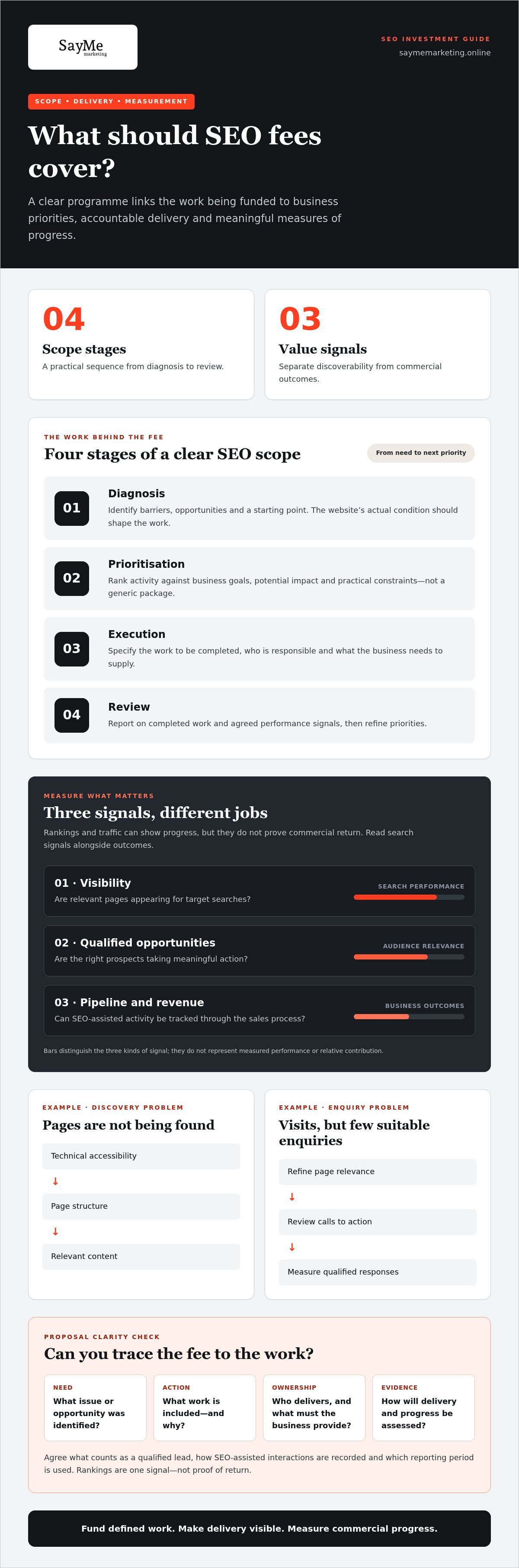
Separate search performance signals, which show progress, from outcomes that indicate business value. Visibility, impressions and rankings can show whether a site is becoming easier to discover. Qualified leads, sales pipeline contribution and revenue help show whether that discovery is reaching the right people and supporting commercial objectives. These measures are connected, but they are not interchangeable.
For example, increased visibility for a broad topic may bring more visits but few relevant enquiries. A smaller increase in visibility for searches closely tied to a business’s offer could attract fewer visitors yet produce better-qualified opportunities. Neither ranking movement nor traffic alone confirms what caused a sale.
- Visibility: Are relevant pages appearing for target searches?
- Qualified opportunities: Are the right prospects taking meaningful action?
- Pipeline and revenue: Can SEO-assisted activity be tracked through the sales process?
Attribution requires suitable analytics and consistent definitions. Agree what counts as a qualified lead, how SEO-assisted interactions will be recorded and which reporting period will be used. Without that framework, teams can mistake correlation for causation or compare results measured by different criteria. A commercially sound programme makes both its work and its performance signals clear.
What should SEO fees cover? Map the proposed scope to the work
A useful proposal connects a diagnosed need to a planned action, a responsible delivery process and a way to assess progress. A list of tasks without that logic is difficult to evaluate. The same activity can be valuable in one programme and wasteful in another, depending on the website’s condition, existing search presence and business priorities.
Business size alone doesn’t determine the work required. A smaller business may have complex technical issues or operate in a crowded niche; a larger organisation may need to resolve workflow bottlenecks before expanding its content. Scope should reflect the actual opportunity and constraints, not a generic package assigned by company size.
Turn deliverables into a clear scope
Group activities by objective, then make the connection between diagnosis and delivery visible. For example, if key service pages aren’t being discovered, the scope might address technical accessibility, page structure and relevant content. If the pages attract visits but few suitable enquiries, the priority may be to refine their relevance and calls to action, then measure qualified responses.
Separate strategic direction from implementation. Strategy sets priorities, explains why they matter and defines how progress will be assessed. Implementation carries out the work, whether that means resolving technical issues, improving pages or developing content. A proposal should state which activities are included, what the business needs to supply and how completed work will be reported.
- Diagnosis: Identify barriers, opportunities and a starting point.
- Prioritisation: Rank work against business goals, impact and practical constraints.
- Execution: Specify the work to be completed and who is responsible.
- Review: Report on delivery and agreed performance signals, then refine priorities.
This structure gives both sides a shared reference for expectations and progress. It also supports grounded investment decisions: resources go towards identified priorities rather than a disconnected stream of tasks. For a deeper breakdown of programme components, the SEO services and programme scope guide explores how the work can fit together.
Account for SEO and AEO in the work
Search behaviour is changing, so a joined-up programme can consider both conventional search visibility and discovery through answer engines. AI-driven SEO and AEO can inform how a business structures and presents useful information, but neither removes the need for sound technical foundations, expert judgement, purposeful implementation or measurement. Tools can assist analysis; people still need to interpret findings and decide what deserves action.
The scope should show how technical priorities, useful content and discoverability reinforce one another. A page designed to answer a genuine customer question still needs to be accessible, accurate and aligned with the business’s offer. Each activity should support a defined objective, with reporting that helps the team learn and adjust rather than simply record tasks.
To assess the commercial logic behind a proposed programme, Evaluating SEO ROI offers a perspective on connecting SEO activity with potential return. SayMe Marketing tailors SEO and AEO programmes to client budgets and priorities, using data-backed decisions and transparent reporting. Explore SEO and AEO programme options to see how a defined scope can support your business objectives.
SEO fee models compared: Understand what each arrangement means
The billing format tells you how an engagement is organised, not whether it’s strategically sound. A retainer can fund sustained optimisation, a fixed-scope project can resolve a defined need, and consulting can equip an internal team to act. Compare the work, planning requirements and ownership attached to each arrangement. The right choice depends on what needs to happen next, not which label sounds most comprehensive.
| Arrangement | Typical scope characteristics | Planning needs | Suitable use cases |
|---|---|---|---|
| Ongoing retainer | Recurring analysis, prioritisation, implementation and performance reviews. | Agree objectives, work priorities, deliverables and review cadence. | Businesses with evolving search opportunities and continuing optimisation needs. |
| Fixed-scope project | A defined piece of work with specific outputs and a clear endpoint. | Set boundaries, access requirements, delivery responsibilities and next steps. | A bounded need such as an audit, migration assessment or strategic plan. |
| Consulting engagement | Specialist advice, analysis or guidance for a team to apply. | Define the questions to resolve, decision-makers and follow-through. | Internal teams seeking direction or input on a particular SEO challenge. |
None of these models is automatically superior. A lower-commitment format may leave important implementation to your team; a broader arrangement may be unnecessary if the need is tightly defined. Assess SEO fees against the work you need delivered, the expertise involved and the resources available on your side. The arrangement should make responsibilities and progress visible, not obscure them.
When ongoing SEO work may fit
Search priorities shift as the business develops, competitors adapt and new performance data emerges. Ongoing work can suit organisations that need a recurring cycle of analysis, prioritisation, execution and reporting rather than a single recommendation. Before committing, establish which deliverables recur, how priorities are reviewed and how often progress is discussed. A retainer without clear outputs and a review rhythm is difficult to manage.
When project-based SEO or consulting may fit
A fixed project can address a bounded requirement, such as diagnosing technical issues or creating a strategic plan. Consulting can help an internal team interpret challenges, set direction or bring specialist input into a decision. In both cases, specify the outputs, who owns implementation and what happens after recommendations are delivered. An audit that nobody acts on, or advice with no internal owner, may have limited practical value.
Choose the format that matches your capacity as well as your objective. If your team can implement recommendations, consulting may help focus its effort; if priorities need continuous execution and review, a recurring programme may be more appropriate. Treat the arrangement as an operating framework. Clear scope, ownership and review points make any model accountable.
How to assess SEO fees against your budget, goals, and expected return
A sound budget decision starts with the business case, not a list of activities. Define what growth should look like, identify the audience and offers that matter, then decide what evidence will show whether the programme is contributing. This gives you a stronger basis for comparing SEO fees than a headline figure or ranking target on its own.
Set commercial objectives before comparing proposals
Be specific about the customers, products or markets you want to reach and the outcome you want search to support. That might mean more qualified enquiries for a priority service, stronger visibility for a key product category or improved contribution to a sales pipeline. Lead volume alone can mislead: more enquiries have limited value if they rarely match your offer or progress to a commercial conversation.
Establish a baseline before work begins. Record current organic visibility and traffic alongside relevant enquiry, opportunity or sales measures. Note any gaps in tracking, seasonality or website changes that could affect comparisons. A realistic starting point helps you interpret movement fairly, rather than treating every change as proof of success or failure.
- Define the objective: Specify the audience, priority offer and business outcome.
- Establish the baseline: Capture current search and commercial performance, including known data limitations.
- Prioritise the scope: Focus planned work on the most relevant opportunities and account for the team’s capacity to implement changes.
- Agree how to measure: Set definitions, data sources, review responsibilities and a reporting cadence before delivery starts.
Match the plan to your operating reality. If your team can only review and implement a limited number of recommendations, a larger backlog won’t create value by itself. Consider the sales cycle too: in B2B, a search visit may precede a qualified opportunity by a substantial period, so early indicators and later pipeline outcomes need to be read together. The potential value of qualified opportunities should inform priorities, but it isn’t a promise of future revenue.
Build an accountable measurement framework
Each data source answers a different question. Google Search Console can show how people find your pages through search, including impressions, clicks and queries. Google Analytics 4 can help assess what visitors do on the site and track configured conversion events. CRM data can show whether enquiries become qualified leads, opportunities or customers. Together, they offer a more useful view than any one platform alone.
Agree what counts as a qualified lead, how organic and assisted interactions are recorded, and who checks data quality. Review SEO alongside other marketing and sales influences, such as paid campaigns, referrals and follow-up processes. Attribution helps assess contribution; it can’t prove that SEO alone caused a sale or guarantee what will happen next.
Build a commercially aligned plan around your priorities and budget. Explore SEO strategy with SayMe Marketing.
How SayMe Marketing approaches SEO fees as a growth investment
SEO investment should reflect the business you’re building, not a standard checklist applied regardless of context. SayMe Marketing tailors programmes to client budgets and business priorities, focusing work on search visibility that supports wider commercial objectives. The aim is a defined, data-backed approach, not activity for its own sake.
That distinction matters. A business focused on generating qualified B2B enquiries may need different search priorities from a multi-niche organisation seeking to strengthen visibility across several areas. In each case, the proposed work should connect to the audience, acquisition priorities and growth objectives that matter. SEO fees make more sense when the investment is tied to that specific purpose.
Align the SEO programme with commercial priorities
SayMe Marketing brings SEO and AEO together with AI-driven analysis to inform decisions about search visibility and discovery. AI can help surface patterns and support research, but useful strategy still depends on interpreting evidence, applying expert judgement and putting the right work into practice. Technology is an input to stronger decisions, not a replacement for them.
SEO and AEO should also sit within the wider acquisition picture. Search activity can support how potential customers find and evaluate a business, whilst other channels and sales processes contribute to the journey. A joined-up strategy considers how these elements relate, then directs attention towards the priorities that best fit the organisation’s objectives and available budget. Expanding a programme simply to make it look comprehensive adds no value.
SayMe Marketing’s team brings over 25 years of combined experience to this work. That experience informs strategic judgement and execution; it isn’t a promise of a particular ranking, lead volume or commercial result. Performance depends on the business context, the work undertaken and factors beyond any one programme’s control.
Make progress visible through reporting
Transparent reporting should show what work has been carried out and how agreed indicators are moving. This gives business leaders evidence to assess progress, identify what deserves further attention and make informed decisions about future investment. Reports are most useful when they connect activity to relevant business priorities, rather than presenting isolated metrics without interpretation.
Data-backed decisions also make it possible to adjust direction as new evidence emerges. If an activity isn’t supporting the agreed objective, the team can investigate, refine priorities and explain the reasoning behind the next step. Clear reporting creates accountability without pretending every change in search performance can be attributed to a single action or that future outcomes are certain.
Choose an SEO programme that fits your priorities, budget and growth ambitions. Explore SayMe Marketing’s SEO services.
Make your next SEO investment a deliberate one
Use your next planning conversation to set a clear investment hypothesis: what business priority should search support, what work could move it forward, and what evidence will guide your next decision? This turns budgeting from a debate about activity into a practical choice about where to focus resources and how to learn from the results.
There’s no value in committing to a programme simply because it promises more activity. Start with the commercial objective, choose a scope your team can support, and give measurement a meaningful role in future decisions. SEO takes sustained effort, but each investment should have a reason and a way to assess its contribution.
SayMe Marketing brings over 25 years of combined team experience to its SEO and AEO work, with a data-backed approach and transparent reporting. Outcomes aren’t guaranteed, but clear priorities and visible evidence create a stronger basis for action. Discuss an SEO strategy with SayMe Marketing, tailored to your business goals.
Frequently Asked Questions
How much do SEO fees cost?
SEO fees vary according to the work required, your website’s current condition, the competitive landscape and your objectives. A meaningful estimate needs a defined scope, not a standalone figure. For example, improving a site with established content may call for different work from addressing technical barriers or building visibility for a new offer. SayMe Marketing tailors SEO investment to client budgets and business priorities.
What factors affect SEO fees?
Scope, technical complexity, content requirements, competition, implementation needs and reporting expectations all shape the investment. Your existing search visibility and the capacity of your internal team matter too. If your developers can implement technical recommendations, the programme may need to account for a different division of work than if implementation support is required. Assess why each priority is included and how it relates to your desired outcome, not just the number of deliverables.
Are monthly SEO fees worth paying?
They can be worthwhile if your business needs regular analysis and action, rather than a single piece of advice. For instance, a business expanding its services may need to review search opportunities as its offer and content evolve. Set a review point to assess what has been delivered, what the evidence indicates and whether priorities still fit. A recurring charge alone says nothing about value; the work and its relevance must remain clear.
Can SEO fees be charged as a one-off project?
Yes. A defined project can suit a specific need, such as reviewing a website before a redesign or producing a strategic plan for an internal team. Set out the final outputs, who will own the recommendations and how they’ll be put into practice. If the project identifies work that requires ongoing optimisation, include it in future planning rather than assuming the initial project covers it.
How can I tell whether SEO fees are delivering value?
Check whether the agreed work is completed and whether the evidence connects it to meaningful business activity. For example, a report showing more organic visits is more useful when you can also assess whether those visits led to relevant enquiries or sales conversations. Compare progress with your starting position and consider other influences, such as campaign changes or seasonal demand. No single metric captures the whole contribution.
Do higher SEO fees guarantee better rankings?
No. Paying more can’t guarantee a particular ranking or commercial result. Search performance also depends on your website, the relevance of its content, competitors and changing search behaviour. A proposal should explain the expertise and work behind its investment, how delivery will be assessed and what decisions reporting can inform. Be cautious of claims that promise specific rankings; focus instead on credible execution and transparent accountability.
Should SEO fees include AEO?
AEO may be relevant if your audience uses answer-led search experiences to discover information and compare solutions. Its role depends on your objectives and the kind of expertise your business needs to make discoverable. For example, a company with complex services may need clear, useful answers supported by sound technical foundations. SayMe Marketing provides SEO and AEO, integrating them into a search visibility approach shaped around business priorities.