


LinkedIn Marketing: A Practical Guide to B2B Growth in 2026
More posts won’t fix a LinkedIn strategy that misses the people who buy. Effective linkedin marketing starts with buyer relevance: reaching the right decision-makers with useful insight, then giving them a reason to trust your business. For B2B teams, activity without a clear audience or commercial purpose is effort without direction.
Posting consistently matters, but it doesn’t tell you whether your content is reaching buyers or influencing a decision. Likes and follower growth can look encouraging whilst leaving harder questions unanswered: which messages build credibility, and which interactions lead to genuine opportunities?
This guide shows you how to build a practical LinkedIn marketing approach around buyer needs and business goals. You’ll see how company pages, employee voices, organic content and paid campaigns can work together, how to choose activity that supports your objectives, and how to measure performance beyond surface-level engagement. The aim is clear: make LinkedIn a more focused, measurable part of your growth strategy.
Key Takeaways
- Give LinkedIn a defined role in your growth plan by tying its activity to a clear business objective.
- Shape your strategy around the buyer roles, priorities and concerns that matter to your organisation.
- Use company-page content, employee perspectives and paid promotion for distinct purposes rather than treating them as interchangeable.
- Build a repeatable linkedin marketing workflow that turns buyer questions and organisational expertise into relevant content.
- Set a baseline and track measures that connect visibility and engagement to enquiries, leads and pipeline contribution.
Why LinkedIn marketing deserves a defined role in your growth plan
LinkedIn marketing combines organic activity, such as publishing useful content and taking part in professional conversations, with paid promotion designed to reach selected audiences. Its value isn’t the number of posts or reactions. It’s the opportunity to put relevant expertise in front of people who influence or make business decisions, and to support that visibility with a clear commercial purpose.
That matters during B2B buying journeys. Potential buyers may be identifying a problem, comparing approaches or building confidence in a supplier before they’re ready to speak with sales. Consistent, specific insight can help your business show how it thinks and what it understands about buyers’ challenges. LinkedIn describes itself as a business and employment-oriented social networking service, making its professional context relevant to organisations seeking to build relationships with other organisations.
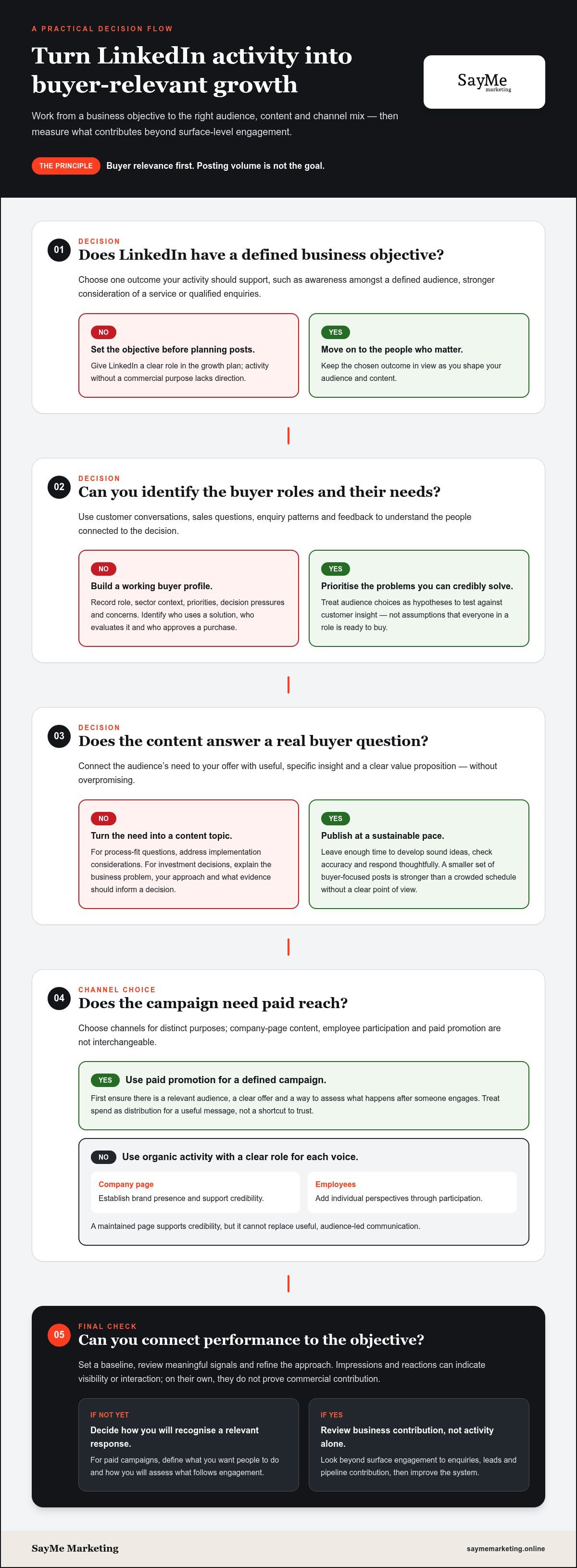
But presence alone isn’t a strategy. Decide what LinkedIn needs to contribute, such as awareness amongst a defined audience, stronger consideration of a service, or qualified enquiries. Then select measures that reflect that objective. Impressions and reactions can indicate visibility or interaction; they don’t, by themselves, prove commercial contribution.
What does LinkedIn marketing include?
The channel brings together several distinct activities: company-page updates that establish brand presence, employee participation that adds individual perspectives, content that answers audience questions, and paid promotion that extends or targets campaign reach. The right mix depends on your objective, available resources and how your intended audience uses LinkedIn. A maintained page supports credibility, but it can’t replace useful, audience-led communication.
Paid promotion can support a defined campaign, but it still needs a relevant audience, a clear offer and a way to assess what happens after someone engages. Before launching, decide what the campaign should prompt people to do and how you’ll recognise a relevant response. Treat spend as a way to distribute a useful message, not a shortcut to trust. The dedicated LinkedIn advertising guide explores paid activity in more detail.
Which businesses can benefit from LinkedIn marketing?
LinkedIn can be relevant for businesses selling expertise, services or solutions to organisations, particularly where professional roles and business needs help define the potential audience. A consultancy, for example, might want to reach senior finance leaders, whilst a technology provider may need to connect with operations teams. Treat these as audience hypotheses to test against customer insight, not assumptions that everyone in a role is ready to buy.
Use the professional communities and decision-making roles connected to your offer to sharpen audience selection. Identify who experiences the problem, who evaluates possible solutions and who approves a purchase. Then align your content and campaigns with the questions each group needs answered. Results depend on the audience, offer, execution and measurement. Set a baseline, review meaningful signals and refine your approach; don’t mistake activity for progress.
Build a LinkedIn marketing strategy around the buyers you need to reach
Start with a commercial objective, not a content calendar. Choose one outcome your LinkedIn activity should support, such as introducing a service to a relevant market, strengthening consideration or generating qualified enquiries. Then define the audience whose actions could contribute to that outcome. A strategy becomes useful when it connects who you need to reach, what they need to know and what you want them to do next.
For a practical overview of LinkedIn marketing as a way to build awareness, generate B2B leads and establish industry authority, Sprout Social outlines the channel’s strategic role. The next step is translating that role into a plan grounded in your own buyer insight, not generic assumptions about professional audiences.
Turn audience insight into a focused LinkedIn plan
Build a working profile from information your business already holds: customer conversations, sales questions, enquiry patterns and feedback. Record the buyer’s role, sector context, priorities, decision pressures and concerns. Note who uses a solution, who evaluates it and who approves a purchase. Then prioritise problems your business can credibly help solve. This keeps your plan specific instead of trying to speak to every potential buyer.
Translate that insight into content decisions. If operations leaders ask how a service will fit existing processes, address implementation considerations. If senior decision-makers need to justify an investment, explain the business problem, the approach and what evidence should inform a decision. A clear value proposition connects that need to your offer without overpromising.
Set a publishing cadence your team can sustain and support with useful thinking. Consistency helps establish recognisable expertise, but volume isn’t the target. Choose a pace that leaves enough time to develop sound ideas, review accuracy and respond thoughtfully to relevant conversations. A smaller set of buyer-focused posts is stronger than a crowded schedule with no clear point of view.
Create content that earns attention and trust
Organise topics around buyer questions, practical guidance and evidence-backed perspectives from your business. For example, a firm addressing procurement challenges could explain common evaluation criteria, share a useful decision framework and discuss a relevant lesson from its work without disclosing confidential client details. Each post should make one point clearly, use a specific example where possible and offer one purposeful next step.
Write openings that name a real tension or question. Replace broad claims such as “we help businesses grow” with a precise observation about a challenge your audience recognises. Make the response useful before introducing your offer. A reader should gain insight even if they don’t click through or enquire immediately.
LinkedIn discovery can work alongside search visibility. If buyers research the same questions on search engines, align your social themes with your wider SEO and AEO strategy, while tailoring each post to professional discussion. Strong linkedin marketing connects audience insight, a credible value proposition and content that advances a defined objective. Build that system around what buyers need to understand, not what is easiest to publish.
Choose the right mix of LinkedIn pages, people and paid promotion
Each part of LinkedIn can play a different role. The company page anchors your organisation’s identity; employee voices bring expertise into professional conversations; paid promotion can put a selected message in front of a chosen audience. Effective linkedin marketing doesn’t mean activating every option at once. It means allocating effort according to your objective, audience behaviour, content capacity and ability to measure what happens next.
Company page or employee voice: where should activity sit?
Use the company page for organisational news, service insights and a consistent brand presence. It gives interested buyers a place to understand what your organisation does. Keep it active, but don’t mistake page activity for audience connection. People-focused perspectives can make expertise more tangible: a specialist might explain a recurring industry challenge, while a leader can share a considered view on a business issue.
Coordinate themes, not scripts. Give colleagues shared topics and useful context, then let them express ideas in their own professional voice. Identical copy across personal profiles feels mechanical; distinct perspectives on the same issue can make your organisation’s expertise clearer. Semrush describes LinkedIn marketing as using the platform to grow exposure and build trust. A coordinated mix of company and employee activity supports that purpose without forcing every post into the same format.
Organic LinkedIn marketing or paid campaigns?
Organic activity supports an ongoing presence. It gives your team room to share expertise, respond to relevant conversations and build recognition over time. Paid promotion serves a more defined campaign role: it can extend the reach of a particular message to a selected audience. Neither approach fixes weak positioning or irrelevant content. Paid reach can amplify a useful offer, but it can also amplify a message that fails to address buyer needs.
Choose the approach by asking what the objective requires:
- Use organic posts to develop a consistent point of view and share practical expertise.
- Use employee perspectives when a human explanation or specialist insight strengthens the message.
- Consider paid promotion when a specific campaign needs to reach an audience beyond your existing organic activity.
Before funding promotion, define the audience, message, next action and measure that will indicate progress. If the offer or post is still unclear, refine it first. If the campaign objective and audience are established, paid activity may help extend distribution. Assess performance against that objective, not reach alone.
The dedicated LinkedIn advertising guide covers campaign targeting and format choices in more detail. Use it to plan the mechanics; keep this section’s principle in view: company pages establish presence, people contribute perspective, and paid promotion supports a specific distribution need. Select the combination your team can execute well and evaluate with discipline.
Launch LinkedIn marketing with a repeatable weekly workflow
A reliable publishing routine turns strategy into visible, reviewable work. It doesn’t require a large content team or a post every day. It requires clear ownership, useful topics and a regular check of whether your activity supports its purpose. Use this weekly workflow as a practical rhythm, then adapt it to your team’s capacity.
- Choose the objective. Select one business priority for the cycle, such as building awareness of a service or encouraging relevant enquiries. Define what action from the audience would support it.
- Select the audience and question. Choose a buyer role or group, then identify a real question, concern or decision pressure that matters to them.
- Pick a content theme. Connect that question to a problem your business can credibly address, your expertise and relevant organisational priorities.
- Assign ownership. Name who will develop the idea, draft the post, review it for accuracy and tone, publish it and monitor responses. Clear hand-offs prevent useful ideas from stalling.
- Prepare and schedule. Add the theme, format, publishing date, intended audience and next action to a shared content calendar. Leave room to respond to timely issues rather than filling every slot in advance.
- Review and refine. Check the planned objective against audience response and any meaningful enquiries. Record what you learned, then use it to shape the next cycle instead of repeating posts by habit.
Plan, produce and publish with consistency
Keep the plan manageable. Choose a small set of recurring themes that connect buyer needs with business goals, such as practical guidance, explanations of common challenges and informed perspectives from your team. Give each post one central message, a clear opening and one relevant next step. Before publishing, check facts, tone, readability and accessibility. A simple calendar makes the work visible and keeps responsibility clear.
Consistency should come from a process your team can sustain, not an arbitrary posting quota. If capacity is limited, prioritise fewer posts with stronger insight over a crowded schedule. Review the calendar regularly so topics remain relevant to buyer questions and organisational priorities.
Use engagement to improve the next cycle
Publishing isn’t the end of the task. Review comments and questions for useful signals: a repeated concern may deserve a dedicated post, whilst a thoughtful disagreement could reveal where your explanation needs more context. Respond promptly and constructively when a reply adds value. Capture recurring questions in the calendar, then use them to refine upcoming topics and angles.
Build the workflow around your team’s actual capacity and keep its purpose visible. For support turning that process into a focused LinkedIn marketing plan, explore how SayMe Marketing can help shape your approach.
Measure LinkedIn marketing by business contribution, then improve the system
A performance report should help you make a decision, not just document activity. Separate indicators of attention from evidence of commercial progress. Reach, impressions and reactions can show whether content is being seen or prompting interaction. They don’t establish that the right buyers engaged, that an enquiry followed or that LinkedIn contributed to revenue.
Start with the objective. If the goal is visibility amongst a defined professional audience, review reach and relevant engagement. If the goal is commercial, look further: assess relevant visits to your website, enquiries, lead quality and, where your tracking and sales processes allow, contribution to pipeline. The right measure depends on what you set out to achieve.
Which LinkedIn marketing metrics should you track?
Choose a small set of measures that connect activity to the intended outcome. A useful reporting view might separate indicators into two groups:
- Visibility and interaction: impressions, reach, profile or page visits, comments and other meaningful engagement.
- Commercial signals: relevant website actions, enquiries, qualified leads and recorded pipeline contribution.
Likes and follower growth can provide context, but don’t present them as proof of revenue impact. A post may attract broad attention without reaching likely buyers. Conversely, a useful post may prompt a small number of relevant conversations that matter more commercially. Read the numbers in context, including the audience, content theme and action invited.
Establish a baseline before assessing change. Record the starting performance for measures tied to your objective, along with the period reviewed and the activity published. Keep the comparison consistent. If you change the audience, content approach and campaign at the same time, it becomes harder to understand which adjustment may have influenced the outcome.
Turn performance reporting into the next decision
Review results at a regular interval that fits your planning cycle. Compare each measure with the objective, audience and content theme, then document what changed, what appears to have worked and what remains uncertain. Treat a pattern as evidence to investigate, not a guaranteed prediction. For example, if a series of posts generates relevant questions but few enquiries, examine whether the next step is clear and whether the offer addresses the concern raised.
Choose one evidence-led adjustment for the next cycle. You might refine the audience, sharpen the message or test a different content angle. Change deliberately, then assess the result against the same baseline and objective. This turns linkedin marketing reporting into an improvement system rather than a monthly list of platform statistics.
SayMe Marketing connects strategy, LinkedIn campaign management and transparent, data-backed reporting as part of a commercially accountable approach. Explore LinkedIn marketing support to build a measurement framework that keeps activity accountable to business goals.
Make your next LinkedIn move deliberate
Your next step isn’t to publish more. It’s to decide what LinkedIn should help your business achieve, then build a disciplined approach around that ambition. Treat linkedin marketing as an investment in buyer understanding and commercial progress, not a stream of posts maintained for its own sake.
That takes clear strategy, consistent execution and reporting that informs the next decision. SayMe Marketing brings more than 25 years of combined team experience to its work, with a data-backed performance focus and transparent reporting. The aim is to keep activity connected to business priorities and make improvement an informed process.
If your current approach feels disconnected from the buyers you need to reach, make the next move count. Explore LinkedIn marketing support and identify a focused path towards stronger B2B growth. You can build a presence with purpose, learn from the evidence and move forward with greater confidence.
Frequently Asked Questions
What is LinkedIn marketing?
LinkedIn marketing is the planned use of the platform to build professional visibility, share expertise with relevant audiences and support business objectives. It can combine organic company-page updates, employee-shared insights and conversations with paid promotion. The strategy determines which mix fits the audience and goal. A consultancy, for instance, might publish practical guidance for prospective clients rather than routine announcements. Activity should create value and direction, not merely keep a profile busy.
Is LinkedIn marketing effective for small businesses?
Yes, LinkedIn marketing can support a small business when its buyers are active in relevant professional networks and its offer answers an organisational need. Company size alone doesn’t determine fit. A specialist firm, for example, can focus on procurement managers in a defined sector and share useful insights drawn from customer questions. Evaluate whether this creates relevant visits or conversations. Performance varies, so treat the channel as a business investment to assess against chosen objectives.
How often should a business post on LinkedIn?
There’s no universal posting frequency that suits every organisation. Choose a schedule your team can maintain whilst producing useful, accurate content. For example, a small team might reserve a regular planning slot, prepare posts around its available expertise and leave capacity to respond to comments. Review audience response alongside workload: if quality slips or publishing disrupts other priorities, adjust the schedule. Consistency and relevance matter more than meeting an arbitrary daily-post target.
Can LinkedIn marketing generate B2B leads?
LinkedIn activity can contribute to B2B lead generation when the audience, offer, content and next step align. A post may prompt someone to visit a service page or request a discussion, but reactions alone aren’t qualified enquiries. Track whether enquiries match your target buyer and progress through your sales process. Results depend on execution, market conditions and the buying journey, so assess contribution over time without assuming a particular lead volume or timeframe.
What is the difference between LinkedIn marketing and LinkedIn advertising?
LinkedIn marketing is the broader discipline. It includes organic company and employee activity, content planning, audience engagement and paid campaigns. LinkedIn advertising refers specifically to paid promotion. Organic activity can sustain a professional presence, whilst advertising supports a defined campaign objective. They can work together, but neither is a substitute for a relevant message. Decisions about campaign formats and targeting mechanics belong in a dedicated LinkedIn advertising guide, where those paid options can be considered in detail.
How do you measure LinkedIn marketing success?
Match measures to the business objective. For awareness, review whether relevant people are seeing or interacting with your content. For a commercial goal, examine useful actions such as service-page visits, enquiries, lead quality or pipeline contribution. A prospect who fits your target profile may matter more than a high-reaction post from an unrelated audience. Record a baseline, review results consistently and note decisions. Engagement alone doesn’t prove revenue impact.
1 Comment
LinkedIn Advertising in 2026: A Practical Guide to B2B Growth
October 13, 2026[…] is where channel planning matters. LinkedIn marketing can help prospective customers find relevant information through organic search, whilst paid […]