


SEO in 2026: Build Search Visibility That Drives Business Growth
What if a page-one ranking is hiding the fact that your SEO isn’t growing the business? Search visibility matters, but rankings alone don’t show whether the right people are finding you, taking action or generating revenue. The terminology can make it hard to know where to begin, while changing search behaviour makes investment harder to assess.
SEO works best as a connected growth discipline, not a checklist of isolated tasks. Technical foundations help search engines access and understand your website. Useful, search-led content answers real needs. Commercial measurement shows whether that visibility contributes to business outcomes. As AI-powered search changes how people discover information, SEO and answer engine optimisation need to work together.
This guide explains how organic search visibility is built, which signals deserve attention and how to distinguish activity metrics from meaningful commercial progress. You’ll learn how to prioritise technical improvements and content, assess performance with greater discipline and understand where SEO can contribute to sustainable growth. The focus is clear: connect every effort to an outcome, and judge visibility by more than its position in search results.
Key Takeaways
- Understand how discovery, crawling and indexing shape whether your pages can appear in search results.
- Use SEO to connect technical foundations and useful content with the people your business needs to reach.
- Look beyond rankings: compare impressions and clicks with qualified enquiries and conversions to assess commercial contribution.
- Build a focused plan by setting business objectives, mapping audience intent, assessing pages, prioritising fixes and measuring progress.
- Pair clear, well-structured answers with strong SEO foundations to support visibility in both traditional search and answer-led discovery.
What is SEO, and why does search visibility matter to a business?
SEO improves a website’s visibility in unpaid search results. That visibility helps people find useful business information when they’re looking for an answer, a service or a solution. Search engine optimisation, commonly abbreviated to SEO, is not simply a way to attract more visitors. It helps relevant pages become easier to discover and understand, so the right audience can find information that matches its needs.
Organic results are listings a search engine selects and displays without a business paying for each placement. Paid placements are advertising, typically labelled as such on the results page. The two can appear alongside one another, but they represent different routes to visibility. A business can improve its website and content to strengthen its eligibility for organic results, but visibility is never a guaranteed source of enquiries or revenue.
What does search engine optimisation include?
Effective SEO connects three workstreams. Technical accessibility helps search engines reach and interpret website pages. Relevant content gives people clear, useful answers. Credible signals, such as consistent and trustworthy information about the business, help establish why a page deserves attention. The Search engine optimization (SEO) overview provides broader context on the discipline and its techniques.
These workstreams depend on one another. Strong content can’t fulfil its purpose if technical problems prevent a page from being found. A technically accessible site still needs material that reflects what its audience is searching for. SEO is ongoing improvement guided by how the site performs and where it falls short, not a one-off website change or a batch of keywords added to pages.
How does SEO support business discovery?
Consider a business buyer researching a solution to a specific operational challenge. Their search query expresses a need. A well-matched service page or useful explainer can help them understand the issue and decide what to do next. The page earns attention by being relevant and clear, not merely by attracting a visit. A large traffic total means little if those visitors have different needs from the people the business can serve.
That distinction changes how businesses should think about visibility. Search exposure creates an opportunity for discovery, while the page experience and the relevance of the offer shape what happens after someone arrives. A useful visit may support research, build familiarity or contribute to a later enquiry. Not every visit converts immediately, and search visibility alone can’t prove commercial impact.
SEO creates sustainable online discovery by making useful business information easier for the right audience to find through unpaid search. Treat it as an input to growth: build accessible pages, address genuine audience needs and assess whether the resulting visits contribute to meaningful business outcomes. That’s a stronger foundation than judging progress by visibility or raw traffic alone.
How SEO works: crawling, indexing and ranking explained
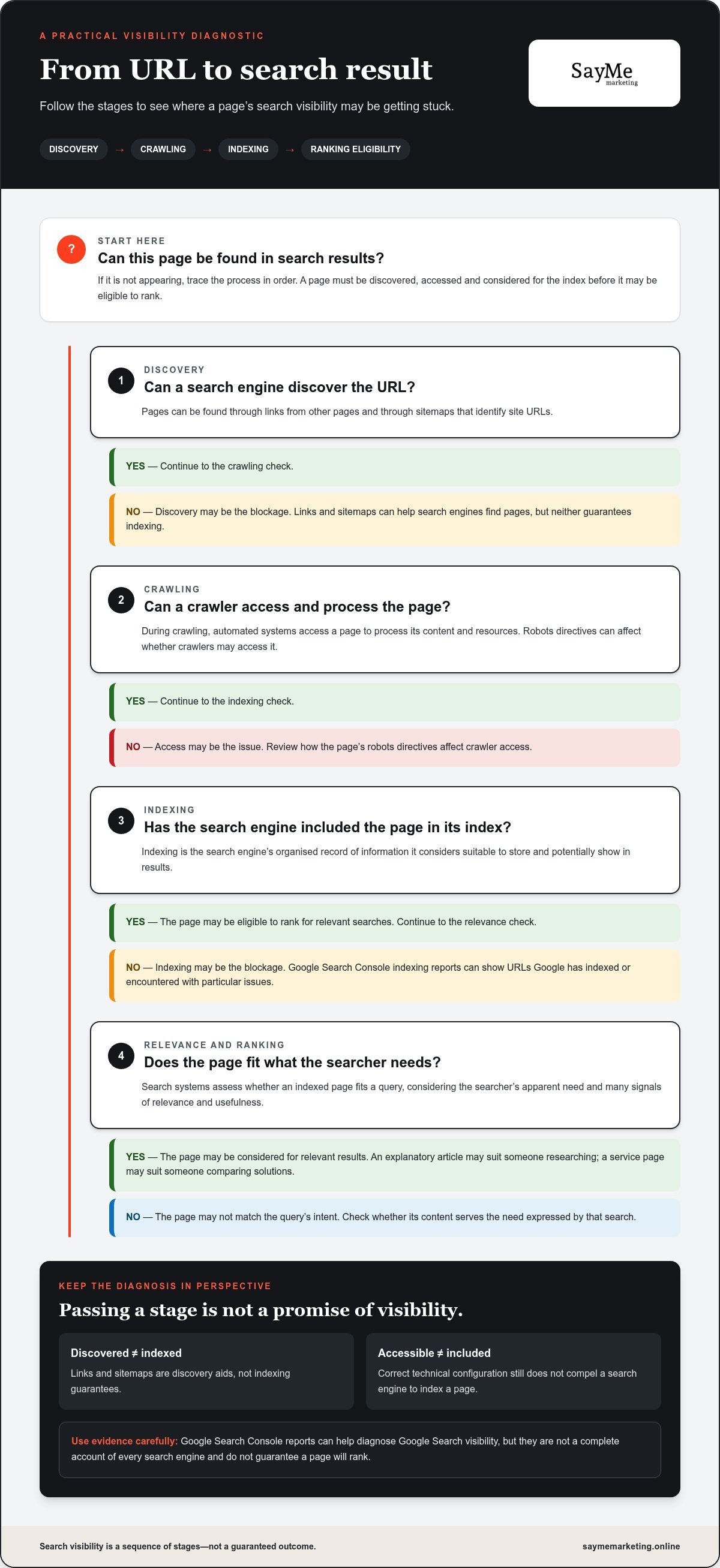
A page can’t appear in search simply because it exists. Search engines need to discover it, access it and decide whether to include information about it in their index. Only then can it be considered for relevant search results. Each stage has a different purpose, so diagnosing a visibility issue starts with finding where the process is breaking down.
Discovery leads to crawling, crawling can lead to indexing, and indexed pages may become eligible to rank for relevant searches. This sequence is a useful model, not a promise that every page will pass through each stage. Search engines decide what to crawl and index. Submitting a URL or making a page technically accessible does not guarantee its inclusion.
How search engines discover and index pages
Search engines can find pages through links from other pages and through sitemaps that identify URLs on a site. These are discovery aids, not indexing guarantees. During crawling, automated systems access a page to process its content and resources. Indexing is the search engine’s organised record of information it considers suitable to store and potentially show in results.
Technical signals influence how that process works. Robots directives can affect whether crawlers may access a page; canonicalisation can indicate which URL should represent similar or duplicate pages; indexing guidance can affect whether a page is eligible for inclusion. Check these settings against current search-engine documentation before changing them. Misapplied instructions can obstruct important pages, while correct configuration still doesn’t compel a search engine to index them.
Google Search Console offers practical visibility into this process. Its indexing reports can help identify URLs Google has indexed or encountered with particular issues, while performance reports show how a site appears in Google Search. Treat these as diagnostic evidence, not a complete account of every search engine or a guarantee that a reported page will rank.
Why relevant pages appear for particular searches
Once a page is indexed, search systems assess whether it fits a particular query. They interpret what the searcher appears to need, then evaluate pages for relevance and usefulness using many signals. A page about a service may suit someone comparing solutions, while an explanatory article may better serve someone still researching a problem.
Technical eligibility and competitive visibility are separate tests. A page may be crawlable and indexed yet still appear low in results, or not prominently at all, because other pages may better satisfy the query. There’s no reliable shortcut or fixed formula. Make each page’s subject clear, address the searcher’s intent directly and ensure key content can be accessed and understood.
For a business, this means checking the right layer before making changes: confirm discovery and indexing first, then assess whether the page deserves stronger visibility for its intended searches. A data-backed SEO and AEO strategy can bring those technical checks into a broader plan for search visibility.
Which SEO signals matter more than rankings alone?
A ranking is a signal, not a business result. A page can appear prominently for a search yet attract few clicks, reach the wrong audience or fail to generate a meaningful next step. Sound measurement follows the path from visibility to commercial action, so you can see where progress is happening and where it needs attention.
Each metric answers a different question:
- Rankings: Where does a page appear for a particular search? Treat position as an indicator, not a verdict. It can vary across queries and over time.
- Impressions: How often did a page appear in search results? This indicates exposure, not whether someone visited.
- Clicks: How many searchers reached the website? Compare clicks with impressions to understand whether visibility is earning visits.
- Qualified enquiries: Are relevant prospects taking a valuable action, such as requesting information about a service?
- Conversions: Are those actions contributing to the business outcomes defined in your objectives?
Which SEO metrics show visibility and engagement?
Google Search Console reports impressions, clicks, queries and page-level search performance. Use it to identify which searches surface your pages and whether visibility is translating into visits. Google Analytics 4 can help assess on-site behaviour and conversions, provided the relevant events and conversion measurement are configured. These tools answer related but different questions.
Tracking quality matters. Missing or inconsistent event setup can hide valuable actions, while attribution settings affect how credit is assigned to interactions that precede a conversion. Document what’s measured, how it’s defined and which reporting period you’re reviewing. Otherwise, apparent changes may reflect measurement differences rather than a genuine shift in performance.
How can a business distinguish progress from vanity metrics?
Start with the objective. If the aim is to attract relevant business buyers, a rise in visits matters only if those visitors engage with suitable pages or take meaningful next steps. Review query and page data alongside enquiry quality. A contact form submission may count as an action, but how well the enquiry fits your offer gives that number its commercial context.
Impressions, clicks and visibility are leading indicators. They can show whether your pages are reaching searchers, but revenue also depends on factors beyond search, including the offer, sales process and customer decision-making. Set a reporting period that suits the objective, compare like with like, and investigate changes rather than claiming certainty from a single metric. This makes SEO more assessable without pretending every outcome can be predicted.
Rankings alone are an incomplete measure of SEO success because they show position, not audience relevance, meaningful action or commercial contribution. A disciplined view connects search visibility to qualified visits and outcomes, while making clear what the data can and can’t establish.
How to build an SEO plan around business priorities
A useful SEO plan doesn’t begin with a long list of keywords. It begins with a business priority: the audience you need to reach, the services or products you want to grow, and the actions that would make search visibility valuable. Use that focus to decide what deserves attention, what can wait and how progress will be assessed.
Build the plan through five deliberate steps:
- 1. Set objectives. Define the business outcome, such as increasing relevant enquiries for a priority service. Identify the action that would show progress.
- 2. Map audience intent. Group searches by the need, question or task behind them, rather than treating every phrase as a separate opportunity.
- 3. Assess existing pages. Check whether each priority need has a useful page, whether that page is accessible and whether its purpose is clear.
- 4. Prioritise fixes. Weigh potential business impact against effort, dependencies and the number of important pages affected. Address issues that block key pages before polishing low-impact details.
- 5. Measure and refine. Record a baseline, track relevant changes and review visibility, engagement and business actions together.
How to turn search intent into useful page priorities
Group searches by what people are trying to accomplish. Someone comparing service options has a different need from someone looking for a definition or a specific next step. Match each priority group to a page with one clear purpose and a relevant action, such as exploring a service or making an enquiry. If several pages target the same need, clarify their distinct roles or consolidate overlapping content. More pages don’t automatically create more useful coverage.
Then assess each page against its purpose. Does it answer the audience’s central question? Is the information specific enough to support a decision? Can the reader see what to do next? These checks turn intent research into practical editorial and technical priorities, not an unfiltered content backlog.
How to measure and refine an SEO plan
Before making changes, capture a baseline for the pages and measures tied to your objective. Keep a simple change log: note what changed, which pages were affected and when. Review on a consistent cadence that gives the work time to be assessed, rather than reacting to every short-term fluctuation. Verify analytics and conversion tracking before drawing conclusions from reported outcomes.
Use the evidence to adjust the plan. If relevant pages gain visibility but not meaningful visits, review how well their content meets search intent. If qualified visits arrive but don’t lead to expected actions, investigate the page experience and the clarity of its next step. Keep conclusions proportionate to the data: search performance can inform decisions, but it can’t isolate every factor influencing a sale.
SayMe Marketing’s SEO and AEO approach connects business priorities, audience intent and measurable reporting.
How SEO and AEO work together to earn lasting visibility
Search visibility now includes more than a list of links. Some search experiences present direct answers alongside, or ahead of, traditional results. Answer engine optimisation (AEO) helps make content clear, useful and easy to interpret in these answer-led experiences. It doesn’t replace SEO. Strong technical foundations and relevant content support discoverability, while precise answers make the information easier to understand and use.
Neither discipline can guarantee that a page will appear in an AI-generated answer. The practical goal is to publish information that deserves to be found: answer real questions, explain claims clearly and make the source’s expertise evident. That creates a stronger foundation for visibility across different ways of searching.
What changes when search results provide direct answers?
With a direct answer in the results, a person may get useful context before deciding whether to visit a website. The path from question to business page can therefore vary: a searcher might click through for detail, compare options or continue researching without a visit. Clear headings and concise explanations help people and search systems identify what a page covers.
Structure information around the question being answered. State the answer plainly, add the relevant context and support factual claims with credible evidence. Keep important details on the page itself rather than relying on vague statements or unexplained terminology. This improves usefulness whether someone reads the page directly or encounters its information through an answer-led interface. It does not guarantee citation or inclusion.
How SayMe Marketing connects SEO with commercial objectives
SayMe Marketing brings SEO and AEO together in an AI-driven visibility approach, connecting technical foundations and search-led content with business priorities. The aim is not activity for its own sake. It’s to establish which audiences matter, what information they need and how visibility can support agreed commercial objectives.
Data-backed, transparent reporting helps make that work assessable. Reporting can show what has been done and how visibility is changing, then relate those observations to relevant business measures. No single metric proves that search activity caused a commercial outcome, so interpretation should account for the objective, the measurement setup and the wider customer journey. That discipline turns SEO and AEO into complementary parts of a considered growth strategy, not competing labels for the same task.
SayMe Marketing’s SEO and AEO services connect traditional search with answer-led discovery and clear business objectives.
Make your next search investment count
The next step is to turn search visibility into a deliberate business priority. Decide which audience you need to reach and what meaningful action you want them to take. Then build a plan that can adapt as your objectives and search behaviour evolve. A disciplined search engine optimisation (SEO) strategy gives your team a clearer basis for deciding what to improve and how to assess its contribution.
SayMe Marketing combines SEO and AEO with a data-backed approach and transparent reporting, connecting visibility work to agreed business objectives. The agency brings more than 25 years of combined team experience.
Build a sharper SEO and AEO strategy with SayMe Marketing. Set a stronger direction for your search visibility and take the next step with confidence.
Frequently Asked Questions
How long does SEO take to show results?
SEO progress usually takes time, and there’s no reliable timetable that applies to every website. Search engines need to revisit pages, while competition, site condition and the scale of planned work all affect progress. Watch for early signs, such as improved access to key pages, separately from business outcomes like enquiries. Set a baseline before changes and assess results across comparable reporting periods rather than expecting an immediate return.
Can a business do SEO without a blog?
Yes, a business can work on SEO without publishing a blog. A blog is only one content format. Clear service pages, product information, case studies and practical guidance can each address a specific audience need. For example, a business could strengthen a service page by explaining who the service is for, what problem it addresses and what the next step involves. Prioritise useful pages over publishing articles without a clear purpose.
Does social media activity directly improve SEO rankings?
Social media activity, such as likes and shares, shouldn’t be treated as a direct lever for higher organic rankings. Social platforms can still help put useful content in front of relevant people, support brand awareness and create opportunities for audiences to visit or reference it. Keep the roles distinct: use social channels to distribute and engage, then assess search performance through search visibility and website outcomes rather than social engagement totals alone.
What happens if a website is redesigned without SEO planning?
A redesign without SEO planning can disrupt existing search visibility. Changing page addresses, removing useful content or weakening internal links may make established pages harder to find or understand. Before launch, record important URLs and their performance, decide which pages need to retain their addresses, and map changed or removed pages to the closest relevant destination. After launch, check key pages, navigation and search reporting so issues can be identified promptly.
Can you do SEO without coding?
Yes, you can handle some SEO tasks without writing code. Most content management systems let users edit page titles, headings, copy, internal links and image descriptions through an interface. Technical diagnosis is different: issues involving site templates, page rendering or configuration may need developer support. A practical approach is to learn the checks you can make safely, document technical issues clearly and prioritise changes according to their effect on important pages.
Is SEO worth it for a small business?
SEO can be worthwhile for a small business when its audience searches online for relevant products, services or expertise, and the business can serve that demand. Start with a focused objective, such as improving a core service page, rather than trying to target every possible search. Track whether visibility brings suitable visitors and meaningful actions. The value depends on relevance, execution and commercial fit, so don’t judge it by rankings alone.