


SEO Digital Marketing Agency: Make Search Visibility Drive Growth
What’s the value of a first-page ranking if it doesn’t bring the right people closer to becoming customers? Search behaviour is changing, and an SEO digital marketing agency must do more than improve positions in traditional results. It needs to help your business get discovered through AI-driven answers too, then connect that visibility to relevant enquiries and commercial objectives.
Rankings and traffic still matter, but they aren’t the finish line. To assess their value, look at which searches attract relevant prospects, whether those visitors take a meaningful action and how performance relates to business goals. A report showing more clicks is only useful if it helps answer the next question: are those visits reaching the right people and supporting the outcomes the business needs?
This article explains how SEO and Answer Engine Optimisation (AEO) work together in an integrated visibility programme. You’ll learn how to prioritise technical improvements and content, which signals matter beyond rankings, and how clear reporting can guide decisions. SayMe Marketing combines AI-driven SEO and AEO with a commercially focused approach to building discovery and qualified demand.
Key Takeaways
- See how an SEO digital marketing agency can connect audience needs with visibility across traditional search and AI-driven discovery.
- Use a clear sequence, from business goals and audience research to technical priorities, content and measurement.
- Separate visibility and engagement signals from lead quality and commercial outcomes to judge performance more accurately.
- Prioritise technical barriers, high-value pages and longer-term authority building according to business objectives.
- Explore how SayMe Marketing connects SEO and AEO with data-backed performance and transparent reporting.
What an SEO digital marketing agency does as search behaviour changes
Search visibility no longer begins and ends with a page climbing a results list. People may discover a business through a conventional result, an answer-led experience or a useful page they find while researching a need. An SEO digital marketing agency plans for that broader discovery journey instead of chasing rankings in isolation.
The work combines strategy and execution. An agency connects audience questions and business priorities to the pages, content and technical foundations that can earn organic visibility. Strategy sets direction; execution turns it into accessible, relevant information. The programme should also define how progress will be assessed, so that visibility is not mistaken for demand or revenue.
SEO remains foundational. It helps search engines understand a website and helps people find relevant pages. A useful overview of the discipline is Search Engine Optimization (SEO). AEO builds on this by organising useful answers so they are easier to interpret in answer-led discovery experiences. It broadens the visibility objective; it does not replace sound SEO.
How SEO and AEO fit within one search strategy
Both disciplines start with the audience. What is someone trying to solve, compare or buy? The answer should shape each page’s purpose, level of detail and next step. A service page, for instance, should explain the offer and make the relevant action clear. An explanatory page should answer a real question with enough context to be useful, rather than simply repeating a search term.
Authoritative content and technically accessible pages support both SEO and AEO. Organise information clearly, write for people and make sure search systems can access the pages. Treating SEO and AEO as separate campaigns can lead to disconnected content and conflicting priorities. An integrated strategy aligns audience intent, content quality and technical implementation across discovery experiences.
Why search visibility must connect to business outcomes
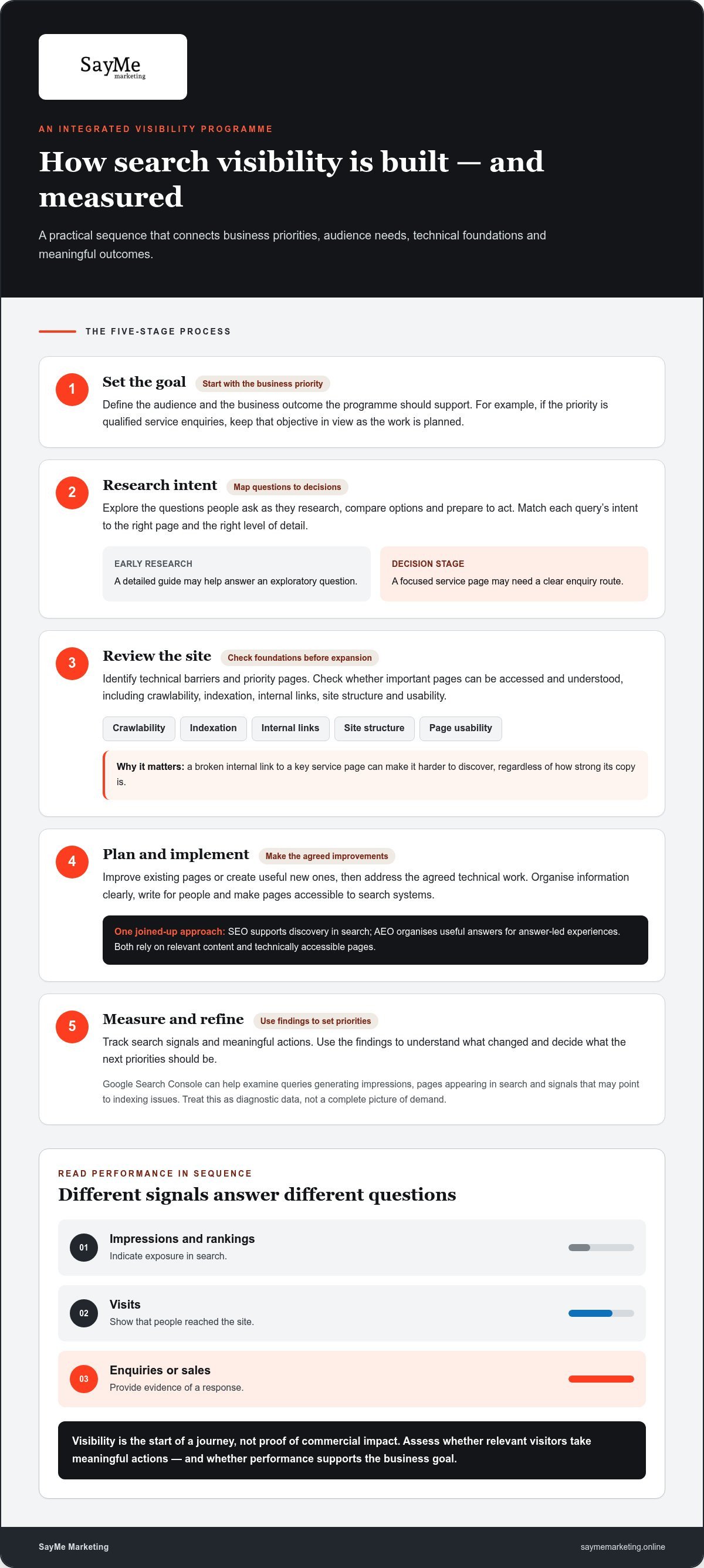
Visibility is the start of a journey, not proof of commercial impact. A relevant search can lead someone to a useful page; that visit may prompt an enquiry, a product selection or another meaningful action. Each step has a different signal. Impressions and rankings indicate exposure, visits show that people reached the site, and enquiries or sales provide evidence of a response.
A high position does not reveal whether a visitor fits your target audience, and traffic alone cannot show whether a page helped generate a qualified opportunity. A ranking for a loosely related query may attract attention without advancing a business priority. Measurement should follow the journey and distinguish search visibility, relevant visits and outcomes instead of treating them as interchangeable.
Search visibility is a business discovery mechanism, not an end metric. An effective SEO digital marketing agency uses that principle to connect search activity with audience needs and measurable objectives. The test is not simply whether a page appears. It is whether the right people can find useful information and take a relevant next step.
How an SEO digital marketing agency builds visibility across search
Visibility comes from a coordinated programme, not a stack of disconnected tactics. An SEO digital marketing agency should turn business priorities into a clear sequence: understand what the organisation needs to achieve, research the audience, assess the site, prioritise pages and content, implement improvements, then measure what changes. Each stage informs the next. Without that structure, content can target the wrong questions and technical work can focus on issues that matter less.
Start with the commercial objective. If the priority is qualified enquiries for a service, research the questions people ask as they compare options and prepare to act. Use that intent to decide which page should serve them, how much explanation it needs and what action makes sense next. An early research query may call for a detailed guide; a decision-stage query may need a focused service page with a clear enquiry route.
- Set the goal: define the audience and business outcome the programme should support.
- Research intent: map questions and search terms to stages of research and decision-making.
- Review the site: identify technical barriers and priority pages before expanding content.
- Plan and implement: improve existing pages or create useful new ones, then address agreed technical work.
- Measure and refine: track search signals and meaningful actions, then use the findings to set the next priorities.
Start with audience intent and technical foundations
Before scaling content, check whether search systems can access and understand important pages. Review crawlability, indexation, internal links and site structure, alongside page usability. For example, a broken internal link to a key service page can make that page harder to discover, regardless of how strong its copy is. Google’s practical SEO Starter Guide outlines foundational considerations for making pages easier to understand and find.
Use Google Search Console to examine which queries generate impressions, which pages appear and whether indexing signals point to issues. Treat this as diagnostic data, not a complete picture of demand. Compare what you see with each page’s intended audience and purpose. SEO and AEO share the same core: useful content built on a site that search systems and people can access.
Create and improve content for useful discovery
Prioritise pages that answer genuine customer questions with specific, well-organised information. Give each page one clear job. Use descriptive headings, concise explanations and relevant evidence to make the answer easy to follow, whether someone is scanning a result or reading in depth. Avoid publishing several near-identical pages for small keyword variations. Strengthen the page that best matches the underlying need.
Structured data can clarify details such as a page’s subject or the type of information it contains. It supports interpretation, but does not guarantee enhanced placement in search results. Review the effect of changes and keep content accurate as your services and audience needs evolve. A joined-up AI-driven SEO and AEO strategy connects content priorities, technical work and measurement rather than treating them as separate tasks.
Which SEO agency signals show meaningful performance, not vanity metrics?
A useful report doesn’t present every number as proof of growth. It separates what the team did, how the site appeared in search, what visitors did next and whether those actions contributed to business goals. For an SEO digital marketing agency, transparent measurement means explaining how each signal fits into that chain, including what it cannot establish on its own.
Match each metric to the question it answers
Use Google Search Console to examine impressions, queries, clicks and indexing signals. These help diagnose search visibility and page discoverability. Google Analytics 4 can show how visitors engage with the site and record configured conversion events, such as a form submission. Define those events before interpreting trends. Otherwise, a change in tracking can look like a change in performance.
| Signal level | What it shows | What it cannot prove alone |
|---|---|---|
| Activity | Work completed, such as technical fixes or content updates. | Whether the work improved visibility or demand. |
| Visibility | Impressions, clicks and ranking movement for relevant searches. | Whether visitors are qualified or likely to convert. |
| Engagement | Whether visitors use relevant pages or take a tracked next step. | Whether the interaction becomes a valuable opportunity. |
| Lead quality | Whether enquiries fit agreed audience or qualification criteria. | Whether a lead will become a customer. |
| Commercial outcomes | Sales, revenue or other agreed business results. | Which channel caused the result without attribution context. |
Read the levels together, but don’t collapse them. Impressions and rankings diagnose exposure; they are not conversions. A conversion event shows that a defined action occurred, not necessarily that it generated revenue. Connect reporting to agreed business goals and keep definitions consistent so comparisons remain meaningful.
Read agency proof points with commercial context
A testimonial can offer useful perspective, and an award can signal recognition. Neither automatically provides independently interpretable evidence of SEO’s contribution. For any reported result, establish the period measured, audience included, starting baseline and exact conversion definition. Then ask how the result was attributed and whether the same method was used throughout the comparison.
Attribution has limits. A prospect might first discover a business through organic search, return through a paid advert and enquire after a direct visit. Reporting models may assign credit differently, and tracking may not capture every interaction. Treat attribution as evidence to inform decisions, not perfect proof that one channel caused a sale. Compare channel data with lead and sales records where available.
Rankings alone can’t prove profitable growth; they show where visibility is changing, not whether that visibility creates valuable business. Be cautious of guaranteed ranking claims and unsupported return-on-investment figures. Look for clear definitions, consistent reporting and an honest account of both contribution and uncertainty.
How to align an SEO agency programme with your business priorities
More activity doesn’t automatically mean more progress. An effective programme starts by deciding what the business needs search to support, then directs effort towards the audiences, pages and improvements most likely to serve that objective. This gives teams a practical basis for prioritisation, even when resources or audience needs are complex.
Set priorities before expanding activity
Define the outcome first. That might be more qualified enquiries for a particular service or stronger visibility for a priority category. Next, identify the audiences who matter, what they need to know and which questions influence their decisions. Map those needs to existing pages before commissioning new content. A focused review can show where the site is unclear, incomplete or difficult to access.
Then rank the work by impact and dependency. A technical blocker that prevents important pages from being discovered may need attention before content expansion. A page that already attracts relevant visitors but fails to explain the offer may be a near-term improvement. Building topical authority is usually a longer-term effort, supported by consistent, useful content rather than a burst of loosely related pages.
- Set the outcome: define the business change the programme should support.
- Choose the audience: identify priority customer groups and their decision-making questions.
- Select the pages: connect those needs to key service, category or information pages.
- Sequence the work: address critical technical barriers, improve high-value content, then build broader authority.
- Match scope to capacity: agree which initiatives can be implemented with available resources and what should follow later.
This sequence also helps determine campaign scope. A business with a focused audience and a small set of priority pages may need a different plan from a B2B organisation serving several audiences with distinct decision journeys. The right programme reflects those differences and the capacity to review content, implement recommendations and follow up on leads. An SEO digital marketing agency should make these trade-offs explicit rather than recommend activity without regard to what the business can deliver.
Make reporting useful for business decisions
Before work begins, agree what success means, which measures will indicate progress and how conversion events are defined. Record a baseline for priority pages and outcomes. At review points, compare like with like, explain material changes and note limits in attribution. If a form event changes or sales follow-up is delayed, interpret the numbers in that context rather than treating a chart as a verdict.
Use reporting to decide whether to continue, refine or reprioritise. If visibility improves but qualified enquiries don’t, examine audience relevance, page usefulness and the next step offered. If outcomes are strong but a priority audience remains difficult to reach, adjust the plan. See how SayMe Marketing approaches SEO and AEO as part of a strategy connected to business priorities and transparent measurement.
How SayMe Marketing connects SEO and AEO with measurable growth
Once priorities and measurement are clear, the next step is an integrated programme built around them. SayMe Marketing brings AI-driven SEO and AEO together, connecting established search foundations with answer-led discovery. The aim is to align the work with business objectives and make performance visible through data-backed reporting, not to promise rankings or revenue.
That distinction matters. Search activity can support commercial goals, but its contribution needs to be measured against agreed signals and interpreted in context. SayMe Marketing applies a strategic, performance-focused approach to organic visibility and wider digital marketing.
Connect search strategy to the wider marketing mix
Organic discovery can work alongside paid campaigns and social distribution. SEO can build a durable base of useful pages; Google Ads can support paid visibility; and LinkedIn or social media marketing can help put relevant messages in front of audiences through other channels. These activities can inform one another, but the right mix depends on the audience, objectives and resources. Not every business needs every channel.
Joined-up planning clarifies the role of each activity. Audience research may reveal questions that should shape an organic content plan, while campaign engagement can point to themes worth exploring further. Marketing strategy gives those insights a commercial frame: which audience matters most, what action should the programme support, and where should effort go first? An SEO digital marketing agency should connect those decisions rather than run channels as isolated workstreams.
- SEO and AEO: support discovery through search results and answer-led experiences.
- Google Ads: add a paid search channel where it fits the campaign objective.
- LinkedIn and social media marketing: distribute relevant content and support audience engagement across selected platforms.
Channel integration is not a reason to expand activity without purpose. It assigns each channel a clear role and gives the business suitable measures for assessing its contribution. Transparent reporting can show what has been implemented, how visibility and engagement are changing, and what those signals suggest about the next decision. It should also make limitations clear, especially where several channels may influence a prospect’s journey.
Take a decisive next step
A strong programme aligns search visibility with qualified demand and accountable measurement. It sets priorities around business objectives, chooses relevant channels and uses evidence to refine the work. That creates a more disciplined basis for decisions than chasing rankings or activity for their own sake.
Bring your objectives and current marketing challenges into the conversation. Explore how SayMe Marketing can align SEO, AEO and complementary marketing activity with your business goals.
Turn search change into your next growth opportunity
Search will keep evolving. Businesses can respond more deliberately by identifying where discovery is weakest, which audience matters most and what decision better search visibility should support. Set a clear next step, then give the programme room to learn and adapt as audience behaviour and channel contribution become clearer.
The right SEO digital marketing agency should help turn that direction into focused action. Look beyond isolated rankings and activity. Build a search programme that strengthens discovery, attracts relevant prospects and gives decision-makers a clearer basis for investment.
SayMe Marketing brings SEO and AEO together with a broader strategic view of digital marketing. Make your next move with a plan shaped around your business priorities and the challenges you need to solve.
With a clear objective and a disciplined programme, changing search behaviour becomes an opportunity to build stronger, more sustainable demand. Plan your next stage of search growth with SayMe Marketing.
Frequently Asked Questions
What does an SEO digital marketing agency do?
An SEO digital marketing agency plans and manages work that helps people discover a business through unpaid search results. Its programme may include query research, technical checks, content improvements and performance reporting. The scope should reflect business priorities and audience needs, rather than follow a fixed checklist. Unlike a directory that lists providers or software that supplies tools, an agency applies expertise to planning and execution. Rankings and revenue aren’t guaranteed.
Is AEO replacing SEO?
No. Answer Engine Optimisation complements established SEO; it doesn’t make traditional search work irrelevant. Both benefit from relevant information, useful content and pages that people and search systems can access. AEO also considers how information can be organised for answer-led discovery, where someone may seek a direct response rather than browse several pages. No content format or technique guarantees that an answer will be selected for an AI-generated response.
Can an SEO agency guarantee first-page rankings?
A responsible agency shouldn’t guarantee a specific position. Search systems, competitors and user behaviour change, and no agency controls every factor that affects rankings. An agency can set priorities, carry out agreed work and report on observable signals such as query visibility, page engagement and qualified enquiries. Treat promises of fixed positions or guaranteed revenue with caution. Ask how progress will be measured, what assumptions underpin the plan and how results will be explained.
How long does SEO take to show results?
There’s no universal timetable. Progress depends on the website’s starting condition, competition, how quickly changes are implemented and the scale of work required. A corrected indexing issue may produce an observable search signal before a broader content programme affects enquiries or sales. Agree a baseline and review periods before work begins. This makes it easier to distinguish early indicators from sustained progress and to avoid treating a short-term ranking change as proven business growth.
How much does an SEO digital marketing agency cost?
Fees depend on the work required, the website’s needs, business objectives and the level of ongoing support. There isn’t one standard programme that suits every organisation. Start by clarifying the outcomes sought, expected deliverables and how reporting will assess progress. Those details make it easier to judge whether proposed work addresses real priorities and whether its intended value is clear. Avoid comparing fees without comparing scope, responsibilities and measurement expectations.
Can SEO and Google Ads work together?
Yes. Organic search and Google Ads can support different routes to discovery. Advertising can provide paid visibility for selected searches, whilst SEO develops a website’s organic presence through ongoing improvements. Shared audience and conversion insights can help shape planning, such as identifying which service questions merit clearer website information. The channels still need their own objectives and measurement. Results depend on execution, budget and market conditions, so combining them doesn’t guarantee lower costs or stronger performance.
What should an SEO report include?
An SEO report should connect agreed objectives with search visibility, website behaviour and defined conversion measures. Google Search Console can help show how pages appear for queries, whilst Google Analytics 4 can report on engagement and configured events. Check that important actions, such as a completed enquiry form, are tracked consistently. A useful report explains changes, flags gaps in the data and identifies next actions. Rankings or traffic totals without that context offer limited decision-making value.